
Energy bills are going up again this winter. From 1 October 2026, Ofgem’s price cap rises 4% to £1,723 a year for a typical dual-fuel home, and gas alone is up 8%. Your roof is the cheapest place to fight back. About a quarter of the heat in an uninsulated home escapes straight through it.
This guide explains what to fix, in what order, what it costs, and which grants Ashford homeowners can actually apply for in 2026.
Bills are rising again this winter; find out exactly where your roof is losing heat.
Book A Free Roof InspectionHow to Make Your Roof More Energy-Efficient: Five-Ways
If you want the short answer, these are the five upgrades that make the biggest difference:
- Insulate your loft to 270mm
The cheapest, fastest win. It brings the roof close to a U-value of 0.16 W/m²K, the standard in Building Regulations Approved Document L.
- Fit a warm roof on flat sections
Rigid PIR board above the deck stops heat loss on extensions, garages and dormers.
- Sort out ventilation at the same time
Soffit and ridge vents keep the roof space dry so the insulation keeps working.
- Upgrade insulation when you re-roof
The roof is already open, so it costs far less than doing it as a separate job later.
- Fix leaks, slipped tiles and perished underlay first
Wet insulation does almost nothing.
If you are not sure what the repairs will cost, our guide to roof repair costs gives you the figures.
Where Ashford Homes Lose The Most Heat
It depends on your home’s age.
- Victorian and pre-war terraces near the town centre often have thin or patchy loft insulation and brittle original underlay. These homes usually have the most to gain.
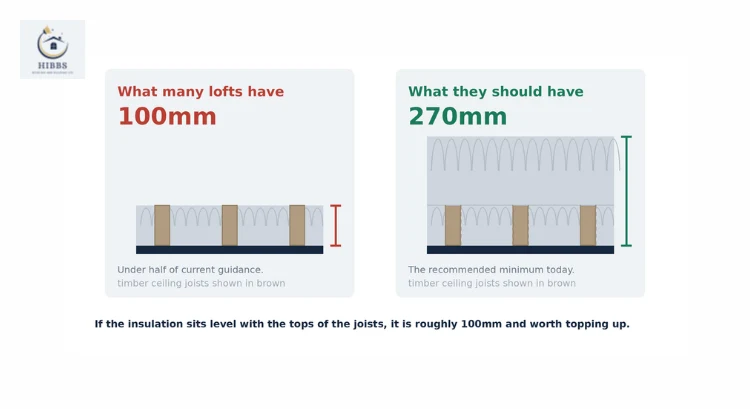
- 1960s to 1980s semis and bungalows across Ashford commonly have 100mm of old insulation. That was the standard then. It is well under half of what is recommended now.
- Loft conversions and rooms in the roof are a special case. There is no loft floor to insulate, so the work has to happen at rafter level.
- Newer estates are generally well insulated, but later flat-roof extensions are often the weak point.
If your upstairs rooms are cold in winter and stifling in summer, the roof is usually the reason.
What Roof Insulation Costs In Ashford, And What You Get Back
Will loft insulation actually cut my bills? Yes, and it is the most cost-effective upgrade available to most homeowners.
Energy Saving Trust 2026 figures for taking a loft from bare to 270mm suggest annual savings of around:
| Property type | Typical annual saving |
|---|---|
| Detached house | £355 |
| Semi-detached | £225 |
| Mid-terrace | £135 |
| Top-floor flat with its own roof | £100–£150 |
Typical 2026 installation costs run from roughly £300–£700 for a two-bed terrace, £500–£1,200 for a three-bed semi, and £900–£1,800 for a four-bed detached. Period properties with awkward access or non-standard joists cost more.
See What You’d Actually Save
Get a fixed quote for your loft and work out your own payback time.
Get A Free QuoteWhat that means in Ashford
Labour rates across the South East sit a little above the national average, but nowhere near central London prices. Most Ashford jobs land in the middle of the bands above. What actually moves your quote up or down is the loft itself: how easy the hatch is to get through, whether the joists are a standard 400mm or 600mm apart, and how much has to be cleared out before anyone can start work. A loft full of boxes and old boarding costs more to insulate than a big empty one. Clearing it yourself beforehand is the simplest way to lower the price.
Most first-time installations pay for themselves in three to five years. After that, the savings are yours every winter.
How long does it last?
Mineral wool typically lasts 40 years or more if it stays dry and undisturbed. Rigid PIR board lasts decades. Moisture is what shortens its life, which is why ventilation matters so much.
Which Insulation Is Right For Your Loft?
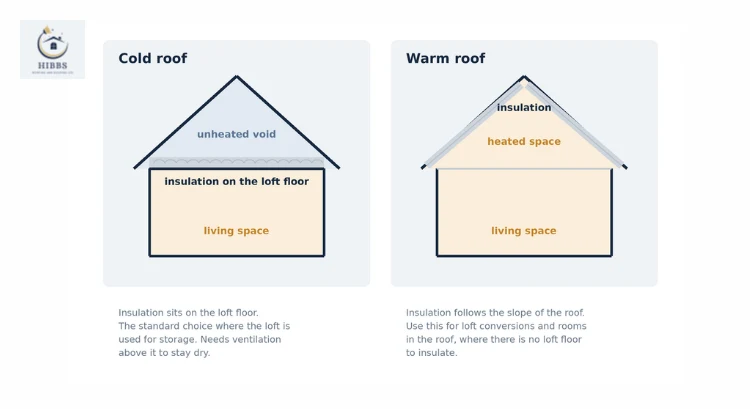
- For a standard cold loft, 270mm of mineral wool laid over the ceiling joists is the usual choice. It is cheap, non-combustible and easy to top up over existing material.
- For a room in the roof or a loft conversion, rigid PIR board is fitted between and under the rafters. It performs better per millimetre, so you lose less headroom.
- For flat roofs, PIR board sits above the deck in a warm roof build-up. EPDM and GRP are waterproofing layers; they provide little insulation on their own.
One thing installers see constantly in Ashford lofts: insulation squashed flat under storage boards. Compressed insulation loses most of its value. If you need storage, the boards must sit above the insulation, not on top of it.
Do You Need Roof Ventilation As Well As Insulation?
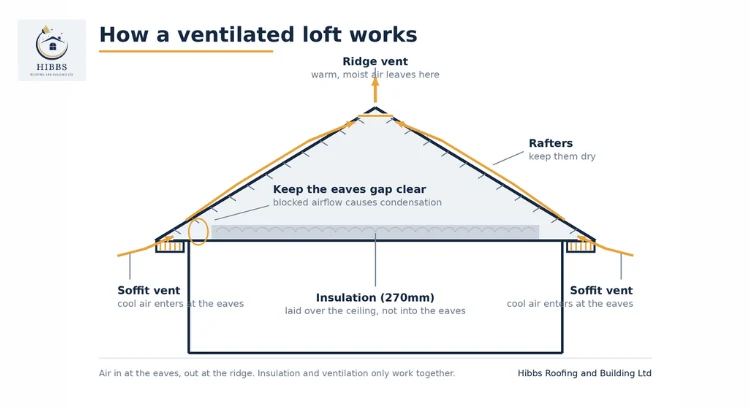
This is the mistake that costs people the most. Seal a roof up without airflow, and moisture from the house collects in the loft. You get condensation, then damp timbers, then soggy insulation that has stopped working.
A well-built roof lets air in at the eaves through soffit vents and out at the top through ridge vents or tile vents. The two need to be balanced. Insulation must never be stuffed tight into the eaves and block the airflow.
If your loft smells musty, or you can see black spots on the rafters, ventilation is the problem, not the insulation. Our fascias, soffits and guttering service in Ashford fits the ventilation a well-insulated roof needs.
How To Insulate An Older Ashford Home With Kent Peg Tiles Or In A Conservation Area
Ashford has a lot of period property, and the usual advice does not always apply.
Kent peg tiles and other heritage coverings are worth preserving, and often protected. Replacing them with modern tiles is rarely an option.
Conservation areas and listed buildings limit what you can change on a roof’s exterior. External insulation and visible vents may need consent.
So use breathable membranes and breathable insulation, and use a roofer who has worked on period property in Ashford before. This isn’t a job for a general builder guessing at it; our advice on choosing the right roofing company in Ashford covers what to ask before you hire anyone.
Roof Insulation Grants In Ashford For 2026
Are there grants for roof insulation?
Yes, for eligible households, but they fund insulation, not roofing.
Here is where things stand in 2026:
- The Warm Homes Plan
Published by DESNZ in March 2026, it commits £15 billion to upgrade up to five million homes by 2030.
- The Warm Homes: Local Grant
Delivered locally by Ashford Borough Council for owner-occupiers and private renters in the borough who are on certain benefits or a low income. It runs to 2028. Grant conditions require a fabric-first approach, meaning insulation comes before solar panels or heat pumps.
- ECO4
Extended to December 2026. There will be no ECO5; the Warm Homes: Local Grant takes over as the main route.
- The Great British Insulation Scheme
Now closed to new applications.
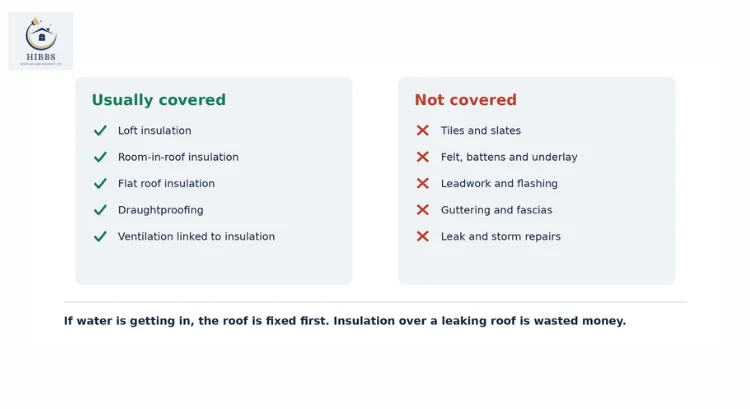
What grants will not cover: tiles, slates, felt, battens, leadwork, guttering or leak repairs. Funding is for energy measures only. If water is getting into your home, fix the roof first, then look at insulation.
Check eligibility through the Government’s checker on GOV.UK, or contact Ashford Borough Council’s warm homes team directly.
Grants don’t cover leaks or repairs; if water’s getting in, fix that.
View Roof Repair ServicesGet An Energy-Efficient Roof In Ashford
Hibbs Roofing and Building Ltd works on homes across Ashford and the surrounding villages. We build insulation and ventilation into every re-roof, and we will tell you honestly if a loft top-up is all your house needs.
Free Roof Inspection
Get An Energy-Efficient Roof In Ashford
We build insulation and ventilation into every re-roof, and we’ll tell you honestly if a loft top-up is all your house needs.
Book A Free Roof Inspection →Related Articles
Frequently Asked Questions
Does re-roofing improve energy efficiency?
Yes, and it is the best moment to upgrade. Under Building Regulations Part L, replacing more than 25% of a roof covering triggers a requirement to bring the insulation up to standard, around 0.16 W/m²K for a pitched roof. Fitting a breathable membrane and new insulation while the roof is open costs far less than doing it separately. It is also when you choose your covering, so it is worth reading up on the types of roofing materials available first.
Can I insulate my roof without replacing it?
Yes. You can add loft insulation, rafter-level insulation, and better ventilation to a sound existing roof. You only need a re-roof if the covering itself has failed.
Does the colour of my roof matter?
Barely, in this country. Light-coloured and reflective roofs reduce summer heat gain, which matters in hot climates. In Kent, your bills are driven by heat escaping in winter, not heat arriving in summer. Spend the money on insulation instead.
Will an energy-efficient roof add value?
Yes. A warmer, cheaper home appeals to buyers, and it improves your EPC rating. That matters more each year: from 2026, EPCs use a new multi-metric format covering fabric, heating and controls, and all rented homes in England and Wales must reach band C by October 2030. Ashford landlords should start planning now.
How do I know if my loft insulation is thick enough?
Measure it. If it is less than 270mm, there is room to improve. Anything under 100mm is well below current standards and worth topping up straight away.
Last updated: September 2026. Savings, costs and grant details are 2026 estimates for guidance only, and grant rules change. Contact us for advice specific to your property.

Pingback: What Is Damp Proofing And Why Your Home Needs It
Pingback: How to Choose the Right Roofing Company: Essential Tips
Pingback: Types Of Roofs In The UK: A Simple Guide