
Knowing how commercial roof installation works helps you plan the job, compare quotes and avoid costly mistakes. Your roof protects everything under it: your stock, equipment, staff, and income. When it fails, the cost goes well beyond the repair bill.
Commercial roof installation is the design and fitting of a new or replacement roof on a non-domestic building, such as a shop, office, industrial unit, school or mixed-use block. It follows a set process: survey, specification, safety planning, strip-out, deck repairs, insulation, waterproofing and handover.
This guide explains each stage in plain English. It covers the main roofing systems, safety rules, asbestos roofs, costs and what a good quote should include. For a broader overview, see our guide to roof types in the UK.
What Is Commercial Roof Installation?
Commercial roof installation means fitting a new roof, or replacing an old one, on a building used for business. It covers offices, retail units, industrial units, warehouses, schools, churches and flats above shops.
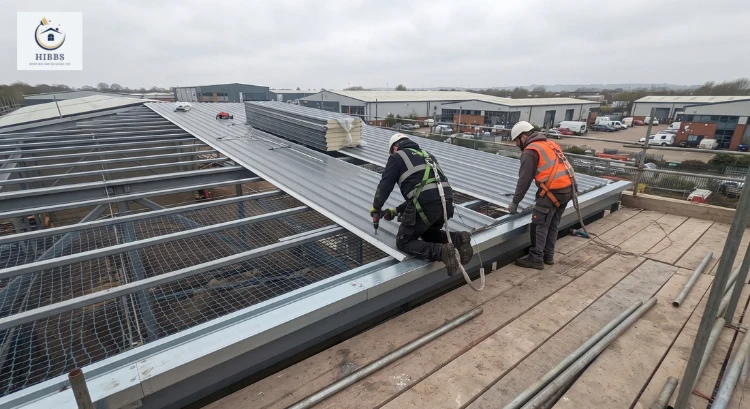
A commercial roof is different from a house roof in four main ways:
- Size: roofs are larger, with wider spans between supports.
- Shape: most are flat or low-pitched, so drainage design matters more.
- Rules: health and safety law and Building Regulations play a bigger part.
- Disruption: the business below usually needs to keep running.
These differences shape every decision, from the system you choose to the way the work is planned.
Which Roofing Systems Are Used On Commercial Buildings?
The right system depends on the building’s use, roof shape, exposure, access, drainage and budget. Most commercial roofs in the UK use one of the systems below.
Single-ply membranes
Single-ply roofs use one flexible sheet to waterproof the roof. The main types are EPDM, TPO and PVC.
EPDM is a synthetic rubber. It is laid in large sheets with few joins, flexes with the building and is installed without heat. TPO and PVC are thermoplastic membranes with heat-welded seams. They suit larger roofs with lots of detailing.
Single-ply systems are light, quick to fit and work well with modern insulation.
Built-up felt systems
Modern felt roofs use two or three layers of reinforced bitumen. They are either torch-applied or cold-applied. These are not the thin felt roofs of the past. A high-performance felt system is tough, proven and good value.
GRP fibreglass
GRP is glass-reinforced plastic laid as liquid resin over a matting layer. It sets into a hard, seamless finish. It suits smaller roofs, walkways and areas with lots of corners and upstands. It needs dry weather to cure properly.
Liquid-applied systems
Liquid systems are painted or sprayed on and cure into a seamless membrane. They work well on complex roofs with many penetrations. They can also refurbish some existing roofs without a full strip-out.
Metal and composite panels
Pitched industrial roofs often use profiled metal sheets or insulated composite panels. Composite panels have insulation bonded between two metal skins. They install quickly over large areas.
Tiles and slate
Some commercial buildings have pitched roofs covered in tiles or slate. Offices in converted houses, pubs, churches and period shopfronts often fall into this group. Our guide to roofing materials explains these options in more detail.
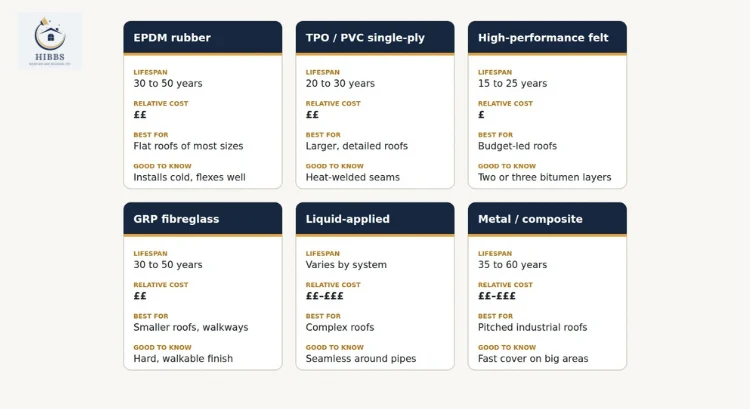
Commercial roofing systems at a glance
| System | Best For | Typical Lifespan | Relative Cost |
|---|---|---|---|
| EPDM rubber | Flat roofs of most sizes, roofs with movement | 30 to 50 years | ££ |
| TPO / PVC single-ply | Larger flat roofs with lots of detailing | 20 to 30 years | ££ |
| High-performance felt | Budget-led flat roofs, industrial units | 15 to 25 years | £ |
| GRP fibreglass | Smaller roofs, walkways, complex shapes | 30 to 50 years | ££ |
| Liquid-applied | Complex roofs, some refurbishments | Varies by system | ££–£££ |
| Metal / composite panels | Pitched industrial and warehouse roofs | 35 to 60 years | ££–£££ |
Lifespan depends heavily on installation. Most flat roofs that fail early fail at the falls or the details, not the membrane itself.
How Commercial Roof Installation Works – Step-by-Step
Every project is different, but a well-run commercial roof installation follows the same core stages.
1. Site survey and condition report
A roofer inspects the existing roof, deck, drainage, rooflights and edges. They check for trapped moisture, wet insulation and signs of asbestos. You should get a written report and a clear recommendation.
2. Specification and design
The survey leads to a specification. This names the system, the insulation type and thickness, the drainage falls and how every detail will be finished. On larger jobs, the manufacturer may also produce a design.
3. Health and safety planning
Commercial roof work is construction work, so it must be planned properly. The contractor prepares risk assessments and method statements (RAMS). These cover access, edge protection, fragile areas and how the public and staff will be kept safe.
4. Access and site set-up
Install scaffolding, edge protection, or other access equipment. Set aside a safe area for materials and waste. Protect or divert entrances, car parks, and walkways as needed.
5. Strip-out or overlay
We remove the old covering in sections, so the building is never left open for long. If the existing build-up is sound and dry, we may be able to overlay it. This means fitting the new system over the old one, which saves time and waste.
6. Deck inspection and repairs
With the old roof off, we check the deck. Replace soft, rotten, or damaged boards. We deal with any decayed timbers or corroded supports before the new roof goes on.
7. Vapour control layer and insulation
We lay a vapour control layer over the deck to stop moisture rising into the roof. Insulation boards go on top. Tapered insulation or firrings can create the correct falls for drainage.
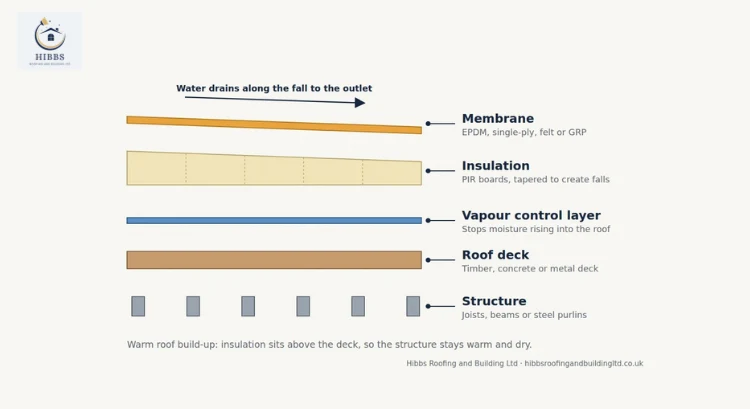
8. Waterproofing system
We install the chosen membrane and bond or fix it to the manufacturer’s instructions. We weld, tape, or seal seams depending on the system.
9. Detailing
We seal and finish upstands, outlets, rooflights, pipes, and edges. These details are where most leaks start, so they need the most care. Where the roof meets walls or chimneys, we fit flashings. Our commercial lead work services cover this stage.
10. Testing, handover and warranty
We test the drainage and inspect the roof. We check and clear gutters and outlets. For roofs that drain to the edge, this is a good time to replace tired gutters, fascias and soffits. We clear the site and hand over the written warranty.
Should An Old Asbestos Roof Be Removed Or Overclad?
Many industrial and commercial buildings built before 2000 have asbestos cement roof sheets. Asbestos cement is generally low risk while it is intact. It becomes dangerous when it is broken, cut or disturbed.
The first step is always an asbestos survey. This confirms what the roof contains and its condition. From there, there are two main options.
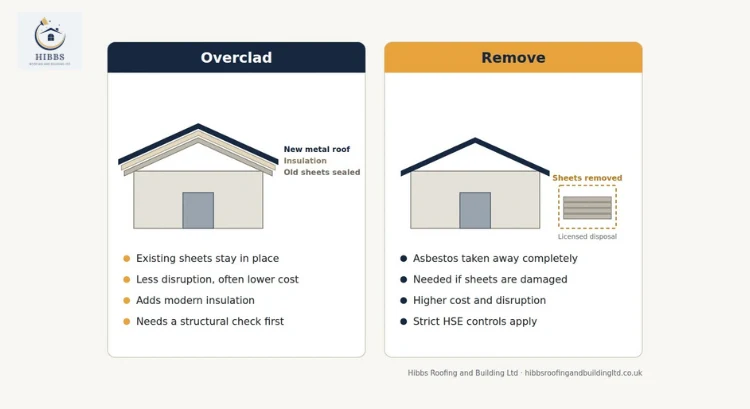
Overcladding fits a new roof system over the existing sheets. The asbestos stays in place, sealed underneath. This is often cheaper and less disruptive than removal, and it lets you add modern insulation. A structural check is needed first to make sure the building can take the extra weight.
Removal takes the old sheets away completely. It is needed when the sheets are badly damaged, or the structure cannot support an overclad. It must be carried out under the Control of Asbestos Regulations 2012, with the right training, controls and licensed disposal.
| Overclad | Remove | |
|---|---|---|
| Disruption | Lower | Higher |
| Cost | Usually lower | Usually higher |
| Adds insulation | Yes | Yes, with the new roof |
| Needs structural check | Yes | Yes |
| Best when | Sheets are intact | Sheets are damaged or failing |
What Safety Rules Apply To Commercial Roof Work?
Falls from roofs are one of the biggest causes of serious injury in construction. Commercial roofs carry extra risks, so several sets of rules apply.
Safety rules that apply to commercial roof work
- Fragile roofs: old asbestos sheets and rooflights can give way under a person’s weight, treat them as fragile unless a competent person confirms otherwise
- Work at Height Regulations 2005: work must be planned to prevent falls, with edge protection, safe access and covers or barriers around rooflights
- CDM Regulations 2015: most roof replacements count as construction work, the client has legal duties and larger projects need a construction phase plan
- Building Regulations: replacing more than half a roof covering usually means insulation must meet Part L, and the covering must meet Part B fire requirements
Before any work starts, ask your contractor for their RAMS. A good contractor will provide them without being asked.
Before any work starts, ask your contractor for their RAMS. A good contractor will provide them without being asked.
Can A Business Keep Trading While The Roof Is Replaced?
In most cases, yes. Good planning is what makes it possible.
How your business keeps trading during the work
- 1 Phased work — the roof is replaced one section at a time
- 2 Flexible hours — noisy or high-risk tasks scheduled early, late or at weekends
- 3 Protection below — stock, machinery and work areas covered or moved where needed
- 4 Weather planning — each section made watertight before the team leaves for the day
- 5 Clear communication — an agreed programme and regular updates
Tell your contractor early about deliveries, busy trading times and any areas that must stay open, the programme can then be built around them.
Tell your contractor early about deliveries, busy trading times and any areas that must stay open. The programme can then be built around them.
How Long Does A Commercial Roof Installation Take?
It depends on the roof size, the system, access, the weather and how much deck repair is needed.
As a rough guide, a small commercial flat roof, such as a single retail unit or office, can often be completed within a week. Larger buildings may take several weeks, especially when the work is phased.
Some systems also depend on the weather. EPDM can be installed in most conditions. GRP and some liquid systems need dry weather and minimum temperatures to cure. A good contractor plans around this rather than rushing the job.
How Much Does A Commercial Roof Cost?
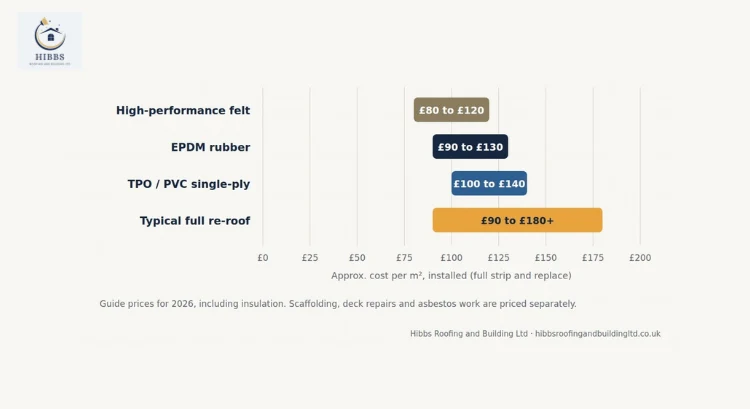
Commercial roofs are usually priced per square metre. As a general 2026 guide for a full strip and replacement, including insulation:
| System | Approx. Cost Per m² (Installed) |
|---|---|
| High-performance torch-on felt | £80 to £120 |
| EPDM rubber | £90 to £130 |
| TPO / PVC single-ply | £100 to £140 |
| GRP fibreglass | Priced per project |
| Metal / composite panels | Priced per project |
Many full commercial re-roofs land somewhere between £90 and £180 per square metre. Higher-specification systems and major deck repairs cost more.
What Affects The Price
- Roof size and shape: more corners, upstands and rooflights mean more labour.
- System choice: felt is usually the most affordable; premium single-ply and liquid systems cost more.
- Access: scaffolding, edge protection and lifting equipment add cost.
- Insulation: upgrading to current standards is often required.
- Deck condition: repairs are only fully known once the old roof is off.
- Asbestos: surveys, overcladding or removal all add cost.
- Working hours: out-of-hours or phased work can take longer.
- Waste: removal and disposal of old materials.
Why Quotes Vary So Much
Commercial roofing quotes often include different things. Some leave out scaffolding, insulation or VAT. Some do not allow for deck repairs. Always compare like with like.
Sometimes a full replacement is not needed at all. Our guide to roof repair costs explains what smaller repairs typically involve.
What Should A Commercial Roofing Quote Include?
A clear quote protects you from surprises. Check that yours covers:
- A summary of the survey findings
- The named system and manufacturer
- The insulation type, thickness and the standard it meets
- Access, scaffolding and edge protection
- How deck repairs will be priced
- Waste removal and disposal
- The programme and working hours
- The type and length of warranty
- Proof of insurance
- RAMS, or confirmation they will be provided before work starts
If a quote is vague on any of these, ask before you sign. Our guide to choosing the right roofing company has more tips.
Repair Or Replace: Which Does Your Roof Need?
Not every tired roof needs replacing. Repairs make sense when:
- The leak is in one area
- The deck is sound and dry
- The roof is well within its expected life
Replacement is usually the better choice when:
- Leaks keep returning in different places
- The insulation underneath is wet
- The membrane is cracked, blistered or splitting across wide areas
- The roof is near the end of its life
A proper survey will tell you which applies. For smaller problems, our commercial roof repair services may be all you need.
How Do Warranties And Maintenance Plans Work?
Most commercial roofs come with two kinds of cover:
- Workmanship guarantee: from the contractor, covering how the roof was installed.
- Manufacturer guarantee: from the system maker, covering the materials. Some also cover workmanship when an approved installer fits the roof.
Many warranties require regular maintenance to stay valid. A simple maintenance plan usually includes inspections twice a year, clearing outlets and gutters, and fixing small defects early. This is the cheapest way to get the full life out of a new roof.
A new roof is also a good chance to cut running costs. Our guide on how to make your roof more energy efficient explains the options.
Plan Your Commercial Roof With A Local Team
Hibbs Roofing and Building Ltd installs and maintains roofs on offices, retail units and industrial buildings across Ashford and Kent. We fit EPDM, GRP and high-performance felt systems, including warm roof upgrades that meet Part L. We schedule the work around your trading hours, so your business keeps moving.
Every project starts with a free survey and a clear, fixed written price. Find out more about our commercial flat roofing in Ashford, or explore our roof installation services in Ashford.
Plan your commercial roof with a local team
We fit EPDM, GRP and high-performance felt systems, including warm roof upgrades that meet Part L, and schedule work around your trading hours so your business keeps moving.
Or call 0800 018 2080 today
Frequently Asked Questions
Do I need planning permission for a new commercial roof?
A like-for-like replacement usually does not need planning permission. You may need it if you change the roof’s height, shape or appearance, or if the building is listed or in a conservation area. Building Regulations may still apply, even when planning permission does not.
Can a new roof go over the existing one?
Sometimes. An overlay is possible when the existing build-up is sound, dry and able to take the extra weight. A survey will confirm whether your roof qualifies.
How long does a commercial flat roof last?
It depends on the system and the installation. High-performance felt typically lasts 15 to 25 years. EPDM and GRP can last 30 to 50 years when the deck and falls are right.
Who is responsible for the roof in a leased building?
It depends on your lease. Under many full repairing leases, the tenant is responsible. In other cases, the landlord keeps responsibility and recovers the cost through a service charge. Check your lease before arranging work.
Does a new commercial roof have to meet current insulation standards?
Usually, yes. If you replace more than half of the roof covering, Part L of the Building Regulations generally requires upgraded insulation. Your contractor should include this in the quote.
