
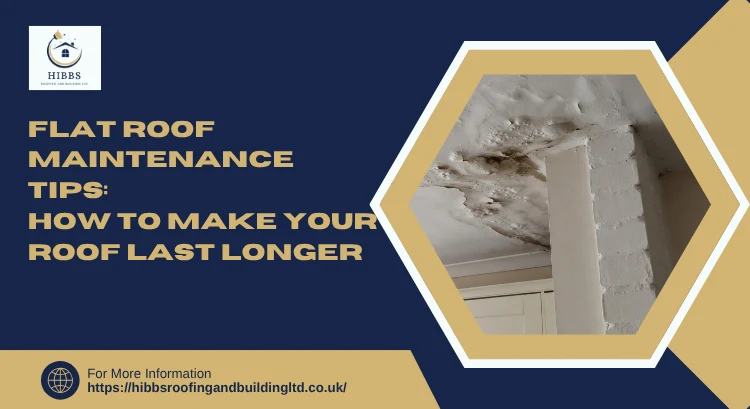
Flat roof maintenance is the simplest way to get the full life out of your roof. Most flat roofs that fail early do not fail because the material wore out. They fail because water sat on them, outlets were blocked, or a small split was ignored until it became a leak.
The good news is that most of the work is quick, cheap and easy to fit around the seasons. This guide covers what to check, how to look after each type of flat roof, the mistakes that shorten a roof’s life, and when it is time to call a roofer.
Flat roofs are common on extensions, dormers, garages and garden rooms across Kent. If you are not sure what kind of roof you have, our guide to the types of roofs in the UK explains the main options.
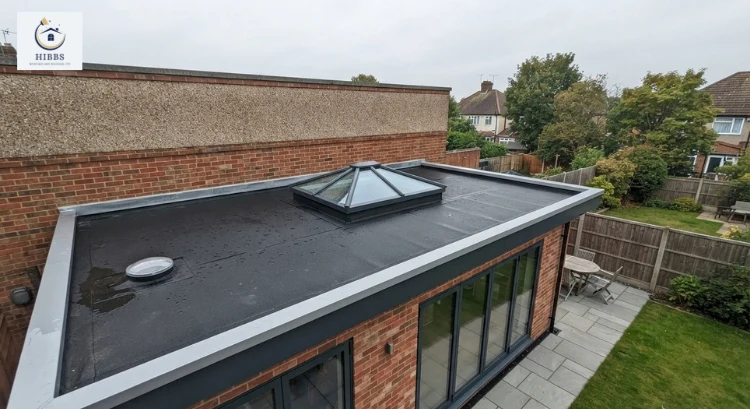
Why Does Flat Roof Maintenance Matter?
A pitched roof sheds water quickly. A flat roof has only a gentle fall, so water moves slowly, and anything that slows it further, such as leaves, moss or a blocked outlet, leaves it sitting on the surface.
Standing water speeds up wear on every roofing system. It softens joints, feeds moss and algae, and seeps into any small defect. Once water gets under the membrane, it soaks the insulation and the timber deck below, and a simple repair becomes a much bigger job.
Regular maintenance catches these problems while they are still small. A few hours a year can add years to a flat roof’s life and save you the cost of an early replacement.
How Long Should A Flat Roof Last?
It depends on the system, how well it was installed, and how well it is looked after.
A neglected roof will usually sit at the bottom of its range, or fail sooner. A roof that is cleaned, inspected and repaired promptly has the best chance of reaching the top of its range.
If you are not sure which system is on your roof, or how old it is, our team can tell you during a quick inspection. We fit and repair all of them as part of our flat roofing services in Ashford and Kent.
How to stay safe before you start
- Use a sound ladder on firm, level ground, set at roughly one metre out for every four metres up
- Have someone hold the ladder or stay nearby
- Wear flat, soft-soled shoes with good grip
- Never go up in rain, frost, strong wind or poor light
- Never stand or lean on rooflights, domes or skylights, many are not designed to take a person’s weight
- Keep well away from unprotected edges
If the roof is high, fragile, or you are not confident, do not go up. A roofer can carry out the inspection with the right access equipment.
If the roof is high, fragile, or you are not confident, do not go up. A roofer can carry out the inspection with the right access equipment.
10 Flat Roof Maintenance Tips
1. Inspect your roof twice a year and after storms
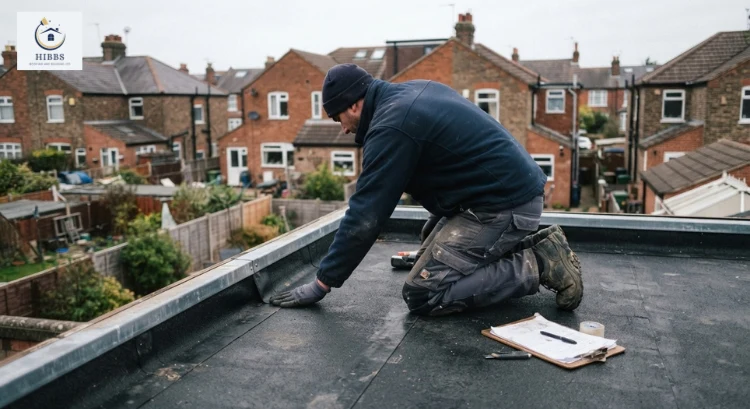
Check the roof in spring and autumn, and again after any heavy storm or high winds. Look over the whole surface, the edges, the outlets and the points where the roof meets walls, chimneys and rooflights.
Take a few photos each time. Comparing them over the years makes it much easier to spot slow changes, such as a seam starting to lift or a patch of ponding getting bigger.
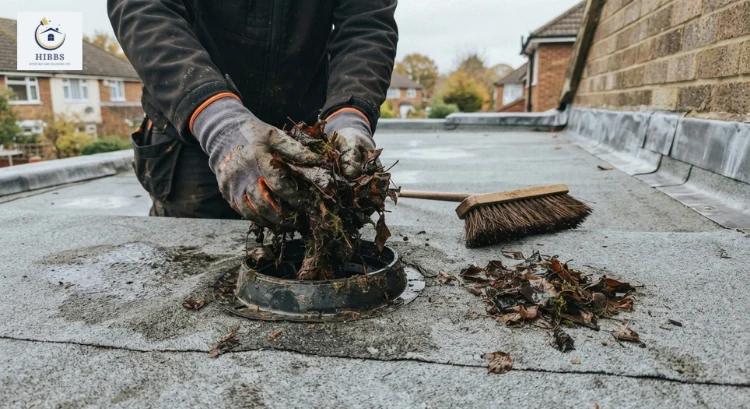
2. Clear leaves and debris with a soft brush
Leaves, twigs, moss and wind-blown dirt hold moisture against the roof and block the drainage. Sweep them off with a soft-bristled brush or use a leaf blower.
Never use a shovel, rake, stiff wire brush or anything with sharp edges. These can scratch or puncture the membrane.
3. Keep outlets, gutters and downpipes flowing
Blocked drainage is the most common cause of flat roof problems we see. Clear the outlets and gutters, check the downpipes are running freely, and make sure water drains away from the building.
If your gutters are old, sagging or leaking at the joints, it is worth replacing them before they cause damp in the walls below. Our fascia, soffit and guttering services in Ashford cover this.
4. Watch for ponding water
A thin film of water after rain is normal. Water that is still sitting on the roof 48 hours after it stopped raining is not.
Persistent ponding usually means the falls are not right, the deck has sagged, or an outlet is partly blocked. Clear the outlet first. If the water still sits there, have a roofer check it before it causes damage.
5. Check seams, edges and upstands
Most leaks start at the details, not in the middle of the roof. Look closely at joints between sheets, the trims around the edges, and the upstands where the roof turns up against a wall.
Signs to watch for include lifting edges, gaps, cracks, loose trims and any area where the membrane has pulled away.
6. Inspect flashings where the roof meets walls
Where a flat roof meets a wall, chimney or pitched roof, it is usually sealed with a lead or membrane flashing. Check that it is still tight against the wall and that the mortar holding it in place has not crumbled.
Loose or cracked flashing lets water run straight down behind the roof covering. At Hibbs Roofing and Building Ltd, our lead work services in Ashford include replacing and re-dressing flashings.
7. Remove moss and lichen carefully
Moss holds water against the surface, and its roots can work into small defects. Brush it off gently once it is dry, then treat the area with a moss killer that is safe for your roofing system.
Always check the product label or the roof manufacturer’s guidance first. Some chemicals can damage certain membranes.
8. Trim overhanging branches
Overhanging trees drop leaves, twigs and sap onto the roof, and branches can scrape the surface in high winds. Cut them back so they are well clear of the roof.
Kent’s tree-lined streets and autumn leaf fall make this one especially important. If the tree is large or protected, use a qualified tree surgeon.
9. Check inside for stains and damp
Some problems show up inside before they are visible on the roof. Check the ceilings and walls under the flat roof for stains, peeling paint, mould or a musty smell.
Look in cupboards and corners too, as water often travels before it shows. If you spot anything, work out whether it is a leak or condensation (see below) before booking a repair.
10. Book a professional inspection once a year
A roofer will spot things that are easy to miss, such as soft areas in the deck, early seam failure or small splits hidden under dirt. An annual check is also the easiest way to plan repairs before they become urgent.
For commercial buildings, a regular maintenance plan is even more important. Our commercial roof installation guide explains how planned maintenance and warranties work together.
How To Maintain Each Type Of Flat Roof
- What to check: seams, edge trims, and points where the rubber is glued around outlets or upstands
- How to clean it: soft brush and warm water with mild washing-up liquid, then rinse
- What to avoid: solvents, white spirit, petrol and bitumen-based products
- Repairs: use only EPDM-compatible primer and repair tape, standard sealants can void the guarantee
- What to check: hairline cracks or crazing in the topcoat, especially around edges and trims
- How to clean it: soft brush and water, or a mild detergent for stubborn dirt
- What to avoid: dragging heavy items across it, and sharp tools to scrape off moss
- Repairs: grind back small cracks and repair with compatible resin and topcoat
- What to check: blisters, splits, cracks, bare patches and lifting laps
- How to clean it: a soft brush only, never jet-wash, it strips the protective mineral surface
- What to avoid: walking on it in hot weather (softens) or very cold weather (can crack)
- Repairs: small splits can often be patched, widespread blistering usually means end of life
What Not To Do On A Flat Roof
Some of the most common flat roof problems we see come from well-meant DIY.
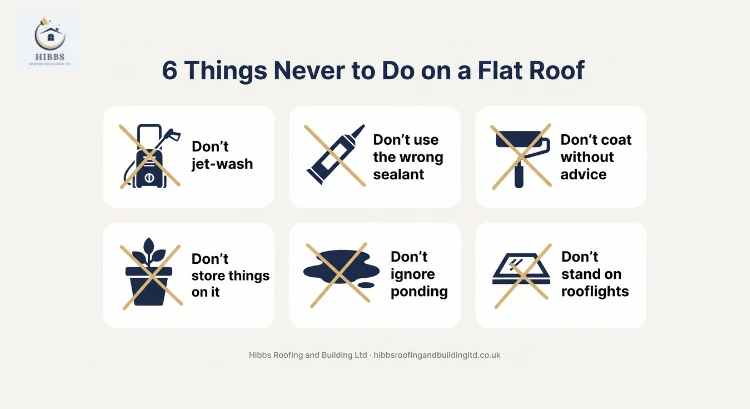
- Do not jet-wash the roof. High-pressure water can force its way under laps and seams and strip the surface of felt roofs.
- Do not use the wrong sealant. Silicone, general-purpose mastic and bitumen paint rarely bond properly to modern membranes, and they can make a proper repair harder later.
- Do not paint or coat the roof without advice. The wrong coating can trap moisture, damage the membrane or void the manufacturer’s guarantee.
- Do not store things on the roof. Plant pots, furniture and equipment put weight on one spot and stop water draining.
- Do not ignore ponding because it dries out. Water that sits for days is still damaging the roof, even if it disappears in summer.
- Do not stand on rooflights. Many are fragile and are not designed to take a person’s weight.
Your Seasonal Flat Roof Maintenance Checklist
Is It A Leak Or Condensation?
Damp patches under a flat roof are not always a leak. Condensation is very common on extensions and garage roofs, especially older cold roofs with little insulation or ventilation.
More likely a leak if…
- The damp appears or grows after rain
- The stain is in one specific area, often near an edge, outlet or wall
- You can see a defect on the roof directly above it
More likely condensation if…
- The damp appears in cold weather even when it has not rained
- It is spread evenly across the ceiling, or appears as black mould around the edges
- The room below is a kitchen, bathroom or anywhere with a lot of moisture
Condensation is usually solved with better insulation and ventilation rather than a roof repair. A roofer can tell you which it is and whether converting to a warm roof would help. Our guide on how to make your roof more energy efficient explains warm and cold roofs in more detail.
Not sure if it’s a leak, condensation, or something worse?
Get a free inspection and a straight answer, plus a clear, fixed price if any work is needed.
Signs Your Flat Roof Needs A Repair
Call a roofer if you notice:
- Blisters, bubbles or raised areas in the surface
- Splits, cracks or tears in the membrane
- Seams or edges lifting or coming apart
- Areas that feel soft or spongy underfoot
- Water still ponding two days after rain
- Stains or damp inside that keep coming back
You can fix most of these with a targeted repair if you catch them early. Our guide to roof repair costs gives an idea of what typical repairs involve.
When Is It Time To Replace A Flat Roof?
Maintenance and repairs can only do so much. A new flat roof is usually the better option when:
- The roof is at or near the end of its expected lifespan
- Leaks keep coming back in different places
- The deck feels soft across large areas, which suggests the timber has rotted
- The surface is covered in splits, blisters or bare patches
- The insulation underneath is wet
In some cases, you can lay a new system over the old one if the existing roof is sound and dry. In other cases, you need to strip it back to check and repair the deck. Our guide to the cost of a new roof covers what replacement typically involves.
Keep Your Flat Roof In Good Shape
Hibbs Roofing and Building Ltd is a family-run roofing company with more than 25 years of experience. We inspect, repair and replace flat roofs on homes, extensions, garages and commercial buildings across Kent.
If you want a second opinion on your flat roof, or you would like it checked before winter, we will give you an honest answer and a clear, fixed written price for any work needed. Find out more about our work as roofers in Ashford.
Want a second opinion on your flat roof?
Family-run, 25+ years across Kent. We inspect, repair and replace flat roofs on homes, extensions, garages and commercial buildings, and give you an honest answer with a clear, fixed written price.
Or call 0800 018 2080 today
Frequently Asked Questions
How often should a flat roof be inspected?
At least twice a year, ideally in spring and autumn, and after any severe storm. A professional inspection once a year is also worth it, especially for older roofs.
Can I walk on my flat roof?
Some flat roofs are designed for foot traffic, but most domestic ones are not. Walk on them as little as possible, avoid hot or frosty weather, and never stand on rooflights.
Does DIY maintenance affect my guarantee?
Cleaning and clearing outlets will not. Using the wrong sealant, coating or repair product can, because most manufacturer guarantees require approved materials and methods.
Can I paint or coat my flat roof?
Only with a product approved for your roofing system. Some coatings can extend the life of an older roof, but the wrong one can trap moisture or damage the membrane. Ask a roofer before you buy anything.
How much does a flat roof inspection cost?
We offer free roof surveys across Ashford and the surrounding villages, so you can find out your roof’s condition at no cost.
