
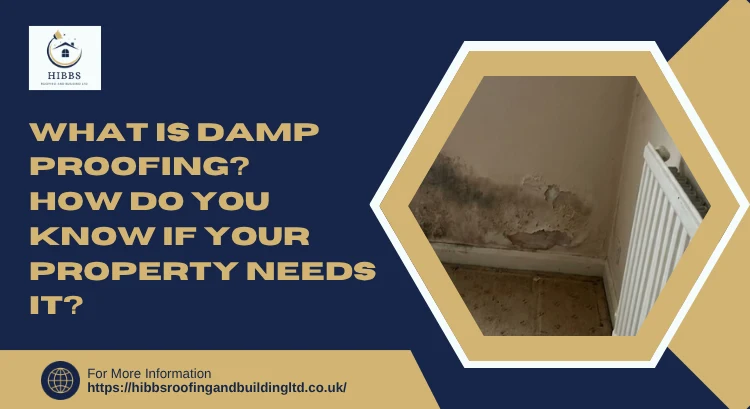
Damp usually announces itself in one of three ways. A patch on the wall that will not dry out. A musty smell in one room. Black mould creeping along a skirting board or around a window.
What happens next is fairly predictable. Someone comes out, runs a meter along the bottom of the wall, and quotes you for a chemical damp proof course. Sometimes that is the right answer. Often it is not.
What Is Damp Proofing?
Damp proofing is any method used to stop moisture getting into a building’s walls, floors and timbers. It is used in two ways: built into new properties as a preventative measure, and added to existing ones as a treatment when something has gone wrong.
The best-known form is the damp-proof course, or DPC. This is a physical barrier built into the wall, normally about 150mm above ground level, that stops groundwater travelling upwards through the masonry. Older properties used slate. Modern ones use plastic or bitumen.
Damp proofing is not the same as waterproofing:
Damp proofing resists moisture at normal pressure, which is what you need in an above-ground wall. Waterproofing, or tanking, resists water under pressure, which is what you need in a cellar or basement. Different problems, different products.
It also helps to be clear on what damp is. The Royal Institution of Chartered Surveyors describes it simply as excess moisture that should not be there.
The Three Types Of Damp, And How To Tell Them Apart
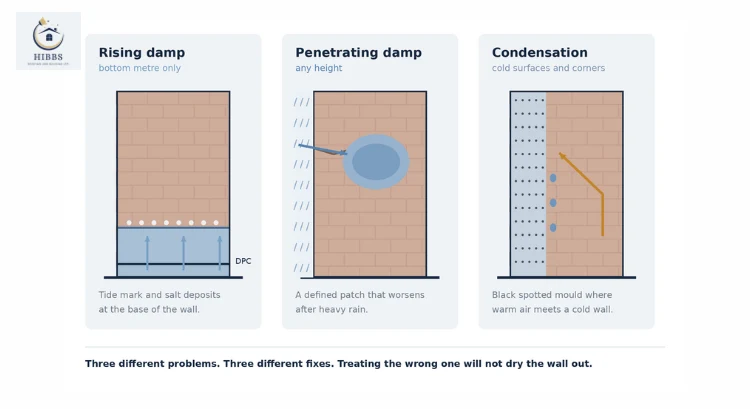
This is the part worth reading twice, because the three types look similar on a wall and need completely different fixes.
Rising damp
Groundwater moves up through porous brick and mortar by capillary action, the same way oil travels up a lamp wick.
Where you see it: only at the bottom of the wall, usually no higher than about a metre.
What it looks like: a tide mark across the wall, peeling wallpaper, crumbling plaster, and white powdery salt deposits left behind as the moisture evaporates.
What causes it: a missing damp-proof course, or more often one that has been bridged or breached rather than failed.
Penetrating damp
Water crossing from the outside of the building to the inside.
Where you see it: anywhere. Halfway up a wall, in a corner, around a chimney breast, on a ceiling.
What it looks like: a defined damp patch or stain that gets noticeably worse after heavy rain and dries back between downpours.
What causes it: cracked or failed pointing, a blocked or leaking gutter, a slipped tile, defective flashing, or cracked render.
Condensation
Water vapour in the air cooling on a cold surface and turning back into liquid.
Where you see it: cold external walls, window reveals, behind furniture, in corners.
What it looks like: black, spotted mould; water droplets on glass; a musty smell. Worse in winter, worse in kitchens and bathrooms, worse in rooms that are not ventilated.
What causes it: moisture from cooking, washing and drying clothes with nowhere to escape, combined with cold surfaces.
Here is the short version:
| Rising damp | Penetrating damp | Condensation | |
|---|---|---|---|
| Where | Bottom metre only | Any height | Cold surfaces, corners |
| Looks like | Tide mark, salt deposits | Defined patch or stain | Black spotted mould |
| Worse when | Fairly constant | After heavy rain | Cold weather, poor ventilation |
| Fixed by | DPC work | External repairs | Ventilation and heating |
Worked out which type matches what you’re seeing? Get it confirmed properly before you spend anything.
Book A Free InspectionHow Do You Know If Your Property Needs Damp Proofing?
Start with three questions. RICS guidance suggests investigating if any part of your home is not dry to the touch, has mould growth, or smells musty. Any one of those is worth looking into.
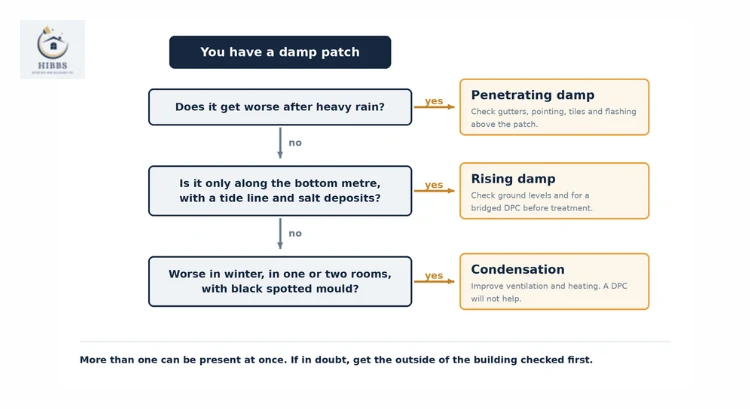
If you ticked one, the next step is to work out which type you have. Ask yourself:
- Does it get worse after rain? That points to penetrating damp.
- Is it only along the bottom of the wall, with a clear tide line? That points to rising damp.
- Is it worse in winter, in one or two rooms, with black spotted mould? That points to condensation.
- Are the gutters overflowing above the damp patch? Go outside during rain and look.
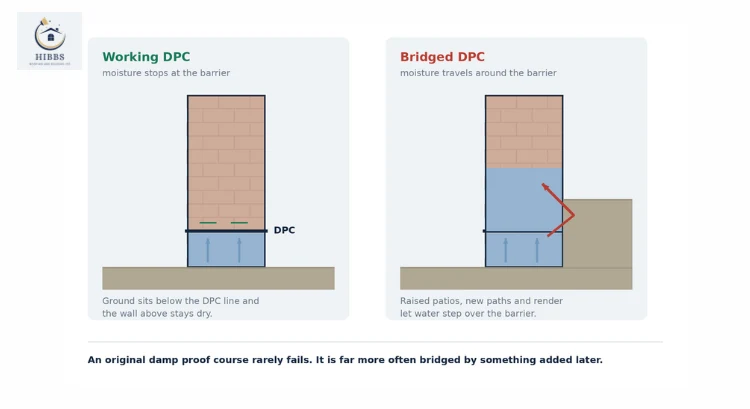
- Is the ground outside higher than the DPC line? Raised flowerbeds, new patios and built-up paths all bridge a damp-proof course that was working perfectly well before.
This matters because the treatments do not overlap. A chemical damp proof course does nothing whatsoever for condensation. A dehumidifier does nothing for a leaking gutter. Getting the diagnosis wrong means paying for work that cannot fix your problem.
Why So Much Damp Gets Blamed On Rising Damp
A long-running argument in the UK surveying world is worth knowing before you commit to anything.
Several senior independent surveyors argue that genuine rising damp is far rarer than the volume of treatment sold would suggest. A former chair of the RICS building surveyors’ faculty has even gone so far as to call true rising damp a myth. Professor Michael Parrett, the building pathologist who helped produce the RICS consumer guidance on damp and mould, is credited with demonstrating how uncommon DPC-failure rising damp really is. Three things sit behind the argument.
Most houses already have a DPC
Properties built from the 1870s onwards generally have one, and an original physical damp-proof course rarely fails outright. Slate does not rot. Usually, raised ground levels, a rendered plinth, or debris in a cavity bridge the DPC.
Moisture meters do not measure water
The handheld meter used in most free damp surveys measures electrical resistance. Salts in old plaster, metal fixings and certain finishes can all produce a high reading on a perfectly dry wall.
The company selling the treatment often carries out the survey
That is not an accusation against any individual firm. It is simply worth knowing who is paying for the free survey.
To be fair:
Rising damp is real, and where it is genuinely present, a chemical damp proof course installed to BS 6576 and paired with proper replastering is the correct fix. The problem is not the product. It is how often it gets prescribed for something else.
We Look At The Whole Building, Not Just Sell A DPC
Sometimes that means damp-proofing. Often it means a gutter repair or some repointing; we’ll tell you honestly.
Get A Straight AnswerThe Damp That Starts At The Roofline
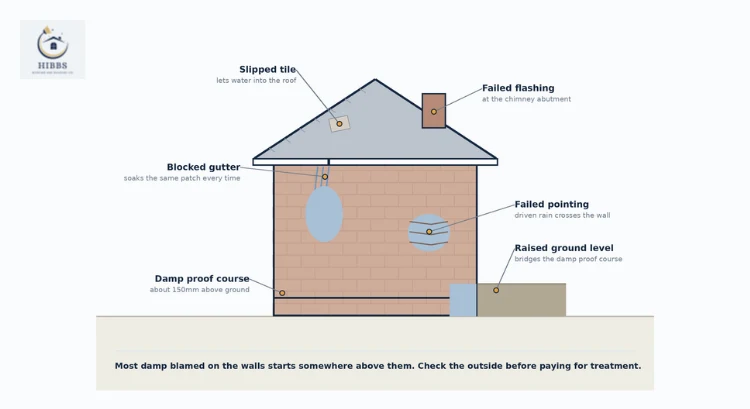
Here is the part most damp proofing companies will not tell you, because it is not their trade.
When independent surveyors investigate damp diagnosed as rising, the real cause is usually one of a short list. Blocked or overflowing gutters soaking the same patch of wall every time it rains. Failed pointing letting driven rain through the brickwork. A slipped tile. Defective lead flashing where the roof meets a chimney. Ground levels built up above the damp proof course.
Every one of those is a building repair, not a damp treatment. And most of them cost a fraction of a chemical DPC.
If you have a damp patch, check the outside of the wall above it before you do anything else. Stand outside in the rain and watch where the water goes. You can spot an overflowing gutter joint in about thirty seconds. Failed lead flashing around a chimney is another common culprit, and one that soaks the same stretch of wall every time it rains.
Before you pay for a chemical DPC, check whether the real cause is a gutter, a tile, or the flashing.
See Roof Repair CostsWhat Damp Proofing Work Actually Involves
Once you know the problem, the options are straightforward. Our damp proofing services in Ashford cover all of the work below.
Damp proof course installation
Either a physical barrier or, more commonly in existing buildings, a chemical cream or fluid injected into the mortar course. Injection work is normally paired with replastering in a salt-resistant renovation plaster, and that second part is not optional.
Damp-proof membranes
Sheet materials applied to walls or floors to hold back moisture, often used alongside other work.
Ventilation improvements
Extractor fans, trickle vents, air bricks and sub-floor ventilation. This helps with condensation and is usually the cheapest work on this list. Loft ventilation matters here too, which we cover in our guide to making your roof more energy-efficient.
External water management
Gutters, downpipes, pointing, roof coverings, flashing and ground levels. The unglamorous option that solves a surprising share of damp problems.
One thing to understand about salts
Long-term damp leaves mineral salts behind in the masonry and plaster. Those salts are hygroscopic, meaning they pull moisture out of the air even after the original leak has been fixed. That is why a wall can still look damp months after the cause is dealt with, and why replastering matters. If someone fixes your damp but doesn’t deal with the contaminated plaster, the patch will come back.
What does damp proofing cost?
It depends on the problem and how much of the property is affected, so the range is wide. Ventilation improvements for condensation sit at the cheap end. A full damp proof course with replastering sits at the other.
Two things are worth knowing before you compare quotes.
Check whether replastering is included. Injection is only half the job. The salt-contaminated plaster has to come off afterwards and be replaced with a salt-resistant mix, and that work often costs as much as the injection itself. A cheap-looking quote often leaves it out.
Prices in the South East run above national averages, so treat figures from national cost guides as a starting point, not what you will actually pay.
Our guide to damp proofing costs in Ashford has the full breakdown.
Older Ashford Properties And Buildings That Need To Breathe
Kent has one of the highest concentrations of listed buildings in England, and Ashford has its share. Timber-framed cottages, Wealden hall houses, oast houses and solid-wall Victorian terraces all behave differently from a modern cavity-wall home.
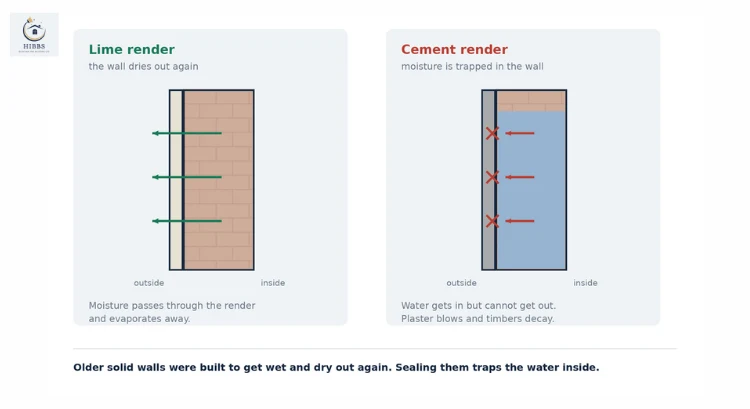
Old buildings were built to get wet and then dry out again. Lime mortar, lime plaster and breathable finishes let moisture move through the fabric and evaporate away.
Seal that up, and you cause the problem you were trying to solve. Cement render on a solid wall, plastic paint, or a non-breathable membrane traps moisture inside the masonry. The wall cannot dry, the damp gets worse, and the timbers start to suffer.
In a period property, damp is very often a breathability and ventilation failure rather than a groundwater one. The fix is usually to remove whatever is stopping the wall from breathing, not to add another barrier.
If your home is listed or in a conservation area, check with Ashford Borough Council’s planning team before any external work.
Damp, Mould And Your Health
Damp is not just a building problem.
Mould affects the lungs and airways, and prolonged exposure can cause serious illness, particularly for children, older people and anyone with a respiratory condition. That is why the rules changed.
Awaab’s Law
Introduced under the Social Housing (Regulation) Act 2023, requires social landlords to investigate and act on reported damp and mould within set timescales. Separate energy efficiency rules mean all rented homes in England and Wales must reach EPC band C by October 2030, which brings ventilation and insulation into the same conversation.
If you rent, report damp to your landlord or agent in writing and keep a record. If nothing happens, your local council’s private housing team can step in.
Get A Straight Answer About Damp In Ashford
Hibbs Roofing and Building Ltd has worked on properties across Ashford for over 25 years, from Victorian terraces to modern estates.
We look at the whole building before we recommend anything. Sometimes that means damp-proofing work. Often it means a gutter repair, some repointing, or better ventilation, and we will tell you.
No Financial Interest In Overselling You
Get A Straight Answer About Damp In Ashford
We look at the whole building before we recommend anything, and we’ll tell you honestly what’s actually causing it.
Book A Free Inspection →Related Articles
Frequently Asked Questions
Is rising damp real, or a myth?
It is real, but far less common than it is diagnosed. Most homes built after the 1870s have a damp-proof course, and an original DPC rarely fails outright. Where damp appears at the base of a wall, a bridged DPC, penetrating damp, or condensation is more likely than a failed one.
Why has my damp come back after treatment?
Two usual reasons. Either the original diagnosis was wrong, and the real cause was never fixed, or salts left in the plaster are drawing moisture from the air. Replace contaminated plaster with salt-resistant renovation plaster; don’t paint over it.
Is a free damp survey worth having?
It is a reasonable starting point, but remember that free surveys are generally carried out by companies that also sell the treatment. If the recommendation is expensive, get a second opinion from someone with no financial interest in the outcome. Our advice on choosing the right roofing company in Ashford covers what to ask before you hire anyone.
How long does damp proofing last?
A correctly installed damp proof course should last decades, and most reputable contractors offer long guarantees. But a guarantee only covers the work that was done. It will not help if the real problem was a gutter.
Can you sell a house with damp?
Yes. It will show up on a buyer’s survey, and the lender may hold back funds until it is dealt with. Getting an accurate diagnosis and a quote before you market the property gives you far more control than leaving it to a survey to uncover.
Does a dehumidifier fix damp?
It manages condensation, which can make a real difference in a poorly ventilated room. It does nothing for rising or penetrating damp, because it does not stop water from entering the building.

Pingback: How to Choose the Right Roofing Company: Essential Tips
Pingback: How Much Does Damp Proofing Cost in Ashford: Avoid Overpaying
Pingback: Types Of Roofs In The UK: A Simple Guide