

The slate roof installation process involves stripping a roof back to the rafters, fitting a breathable membrane and graded battens, then laying and fixing natural or man-made slates in overlapping courses. Done properly, a slate roof will outlast almost every other covering on a British house.
Done badly, it leaks within a few winters. Slate is less forgiving than tile, because the pitch, the head lap and the fixings all have to be right.
This guide explains how the work is done, which slates suit which homes, what the standards require and what it costs. Slate is one of the longest-lasting roof types in the UK, still found on terraces, cottages, and period homes across Kent.
What Is Slate Roof Installation?
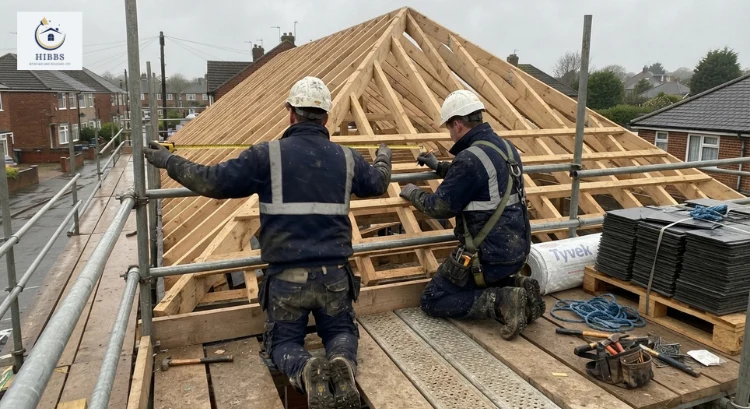
Slate roof installation covers both a new slate roof and a full re-slate of an existing one. The old covering comes off, the timbers are checked, and a new membrane, battens and slates go on.
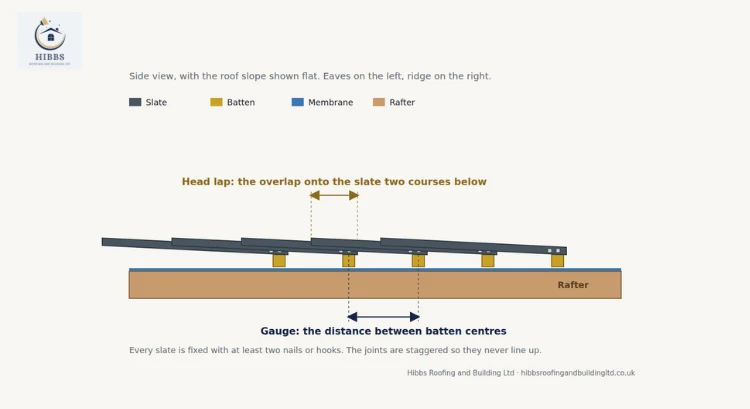
Unlike interlocking tiles, slates do not clip together. Each slate is laid in a double-lap pattern, so every part of the roof is covered by at least two layers. The overlap, pitch, and fixings work together to keep water out, not the slate alone.
A slate roof is one form of pitched roof, and our guide to pitched roof installation covers the wider process.
Which Slate Suits Your Home?
The choice affects cost, weight, lifespan and appearance. These are the options people ask about most.
Welsh slate
The benchmark. Welsh slate is dense, consistent and famously long-lived, regularly passing a century and often far more. It costs the most, and it takes longer to fit because each slate is cut and holed with care.
Best for period homes, conservation areas and anyone who wants a roof they will never replace.
Spanish slate
The most commonly fitted natural slate in the UK today. Good-grade Spanish slate performs well in our climate, looks close to Welsh slate to most eyes, and costs noticeably less.
Best for most re-slating jobs where you want natural slate at a sensible price.
Reclaimed slate
Salvaged slate from old roofs. It weathers in beautifully and often matches neighbouring properties, which matters on terraces and in conservation areas. Quality varies, so slates need sorting and any that are thin, cracked or delaminating should be rejected.
Best for period properties and repairs where matching the existing roof matters.
Fibre-cement slate
A man-made slate made from cement and reinforcing fibres. Light, uniform and much cheaper, with a shorter life.
Best for budget-led projects, outbuildings and roofs where weight is a concern.
Synthetic and composite slate
Moulded from resin and recycled materials. Lightweight, easy to cut and consistent in size.
Best where you want the look of slate at a lower cost, though it will not last like the real thing.
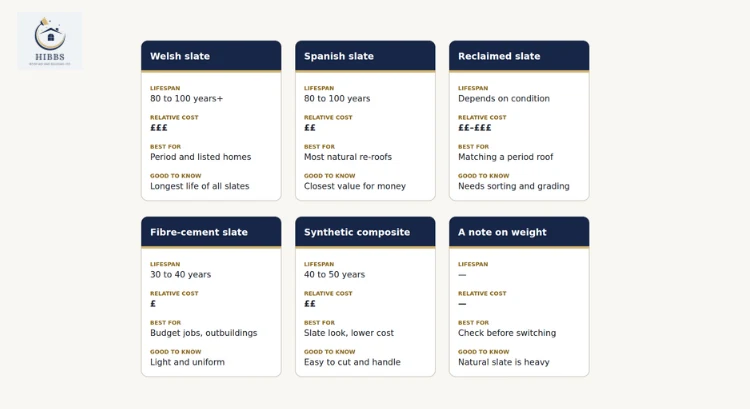
Slate options compared
| Slate | Typical Lifespan | Relative Cost | Best For |
|---|---|---|---|
| Welsh slate | 80 to 100 years, often longer | £££ | Period homes, conservation areas |
| Spanish slate | 80 to 100 years | ££ | Most natural slate re-roofs |
| Reclaimed slate | Depends on condition | ££–£££ | Matching an existing period roof |
| Fibre-cement slate | 30 to 40 years | £ | Budget projects, outbuildings |
| Synthetic composite | 40 to 50 years | ££ | Slate look at lower cost |
If you are still comparing slate with clay, concrete or metal, see our guide to roofing materials. Slate and clay tiles are laid differently, so our tiled roof installation guide is worth reading alongside this one.
Slate Roof Installation Process, Step-By-Step
1. Survey and specification
The roofer measures the pitch, checks the timbers and assesses how exposed the property is. Those three things decide the slate size, the head lap and the fixing method. A proper quote names all of them.
2. Scaffolding and protection
Scaffolding with edge protection goes up. Re-slating a whole roof from ladders is neither safe nor acceptable.
3. Stripping the old roof
We remove the old slates and battens section by section. We stack and sort slates worth keeping for re-use.
4. Checking the timbers
We inspect and repair rafters, wall plates, and fascias while the roof is open. We remove old nails and debris to prevent anything from puncturing the new membrane.
5. Breathable membrane
We lay a breathable underlay from the eaves upwards with the correct laps. It is the roof’s second line of defence and helps keep the loft free of condensation.
6. Battens
Fix timber battens across the rafters at the gauge set by the slate size and head lap. They must be strength-graded to BS 5534, treated, and joined over rafters, never bunched on the same rafter.
7. Eaves course and first slates
Lay a shorter under-eaves course first, giving a double layer of slate at the eaves. The bottom edge must sit far enough forward to drain into the gutter.
8. Slating up the roof
Lay slates in courses, with each one centred over the joint below, so the joints never line up. Fix every slate with at least two fixings. Keep courses straight to a line, because every wavy course shows on slate.
9. Valleys, abutments and verges
Valleys, chimneys and wall abutments are finished in lead. This is where most slate roofs leak, so the detailing matters as much as the slating. Our guide explains how to install lead flashing.
10. Ridge, clean-up and inspection
The ridge is fitted and mechanically fixed, ventilation is completed, and the roof is inspected before the scaffold comes down. If the fascias, soffits and gutters are tired, replace them while the access is up.
Roof Pitch And Head Lap: Why They Matter
Head lap is the amount one slate overlaps the one two courses below. It is the single most important measurement on a slate roof.
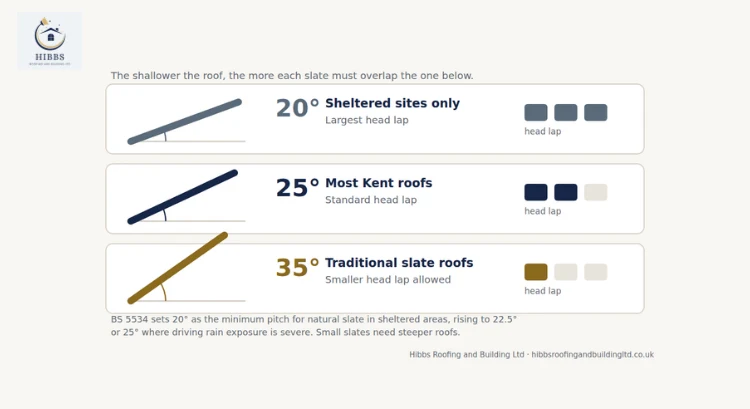
Under BS 5534, the minimum pitch for natural slate is 20 degrees in sheltered locations, rising to 22.5 or 25 degrees where driving rain exposure is severe. The lower the pitch, the greater the head lap needs to be, because water runs more slowly and wind pushes it further up the laps.
Slate size matters too. Small slates cannot be used on shallow roofs: slates 450mm long or less should not be used at pitches of 27.5 degrees or below in moderate and severe exposure.
Kent sits in a moderate exposure zone for most inland areas, with more exposed conditions nearer the coast. A roofer should work out the head lap for your roof rather than using a standard figure.
Nails Or Hooks: How Slates Are Fixed
There are two accepted ways of fixing slates.
Nailing is the traditional method. Fix each slate with at least two nails, either centre-nailed or head-nailed, depending on the slate size and exposure. Use copper or stainless steel nails that penetrate the batten by at least 15mm. Galvanised nails corrode long before good slate wears out.
Hook fixing uses a stainless steel hook that grips the bottom edge of each slate. Hooks suit steeper roofs and exposed sites, and they make future repairs easier. They are generally used above 25 degrees, and below 30 degrees the hooks should have crimped shanks. Perimeter slates are also nailed.
The right method depends on the pitch, the exposure, and the look you want. Hooks are visible from the ground, which some people dislike on a period property.
The Standards A Slate Roof Should Meet
You do not need to know these in detail, but a good roofer works to them:
- BS 5534 is the code of practice for slating and tiling. It covers battens, underlays, fixings, head laps and wind uplift.
- BS EN 12326 sets the requirements for natural slate itself, including thickness and quality grading.
- BS 6915 covers lead sheet work for flashings and valleys.
Since the 2015 amendments to BS 5534, mortar alone is no longer accepted as the only way to hold ridges and verges. They must also be mechanically fixed.
Building Regulations also apply. If you replace more than half the roof covering, the insulation usually has to meet current Part L standards. A re-slate is your best chance to make your roof more energy efficient.
How Much Does A Slate Roof Cost?
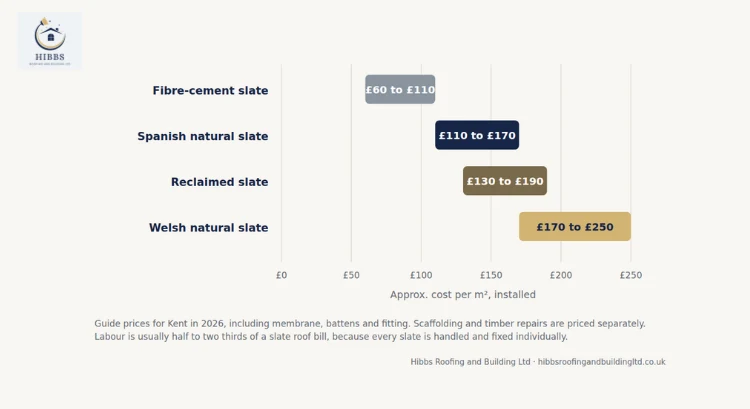
Slate costs more than tile, mainly because of labour. On most slate jobs, labour is between half and two-thirds of the bill, since each slate is handled, holed and fixed individually.
As a general 2026 guide for a full strip and re-slate in Kent:
| Slate | Approx. Cost Per m² Installed |
|---|---|
| Fibre-cement slate | £60 to £110 |
| Spanish natural slate | £110 to £170 |
| Reclaimed slate | £130 to £190 |
| Welsh natural slate | £170 to £250 |
For a whole roof, a typical three-bedroom semi usually falls between £9,000 and £15,000 in Spanish or fibre-cement slate, and between £14,000 and £24,000 in Welsh or reclaimed slate.
Prices in Kent and the South East sit above the national average because labour costs more here.
What affects the price
- Slate choice: the single biggest variable.
- Roof size and shape: valleys, dormers and hips add days.
- Scaffolding: usually £700 to £1,500 on an average semi, more for three storeys or poor access.
- Timber repairs: only fully known once the roof is stripped.
- Lead work: new valleys and flashings are often needed at the same time.
- Waste: old slates and battens have to be removed, though sound slates may have resale value.
Online cost guides vary widely because some exclude scaffolding, strip-out, or VAT. When you compare quotes, check that each one covers the same work.
How Long Does A Slate Roof Last?
Natural slate typically lasts 80 to 100 years, and good Welsh slate often lasts a century or more. Fibre-cement slate lasts around 30 to 40 years, and synthetic composite around 40 to 50.
In practice, the fixings usually fail before the slate does. Old nails corrode and let slates slip, which is why many Victorian roofs need re-slating while the slates themselves are still sound. If your slates are in good condition, you can often reuse them on the new roof.
Signs Of A Poorly Installed Slate Roof
Worth knowing before you accept a job as finished:
- Wavy or uneven courses
- Slates fixed with a single nail
- Mortar-only verges and ridges with no mechanical fixings
- Head lap that looks too small for the pitch
- Torn or sagging membrane visible at the eaves
- Galvanised nails instead of copper or stainless
- Cement fillets instead of proper lead flashing
- Slates that rattle or lift in the wind
Our guide to choosing the right roofing company covers what to check before you sign anything.
Does Your Slate Roof Need Repairing Or Replacing?
A few slipped slates do not mean the roof is finished. Repair usually makes sense when the slates are sound, the problem is limited to one area, and the timbers are dry. Our roof repair services in Ashford cover jobs like these.
Replacement is the better option when slates are slipping across the whole roof, many are cracked or delaminating, the battens have rotted, or leaks keep appearing in different places. At that point, repairs only buy time, because the next slate will slip somewhere else.
A survey will tell you which applies to your roof, and our guide to roof repair costs explains what smaller repairs typically involve. If the slates themselves are still sound, they can often be salvaged and relaid on the new battens, which keeps the roof’s character and reduces material costs.
Planning A Slate Roof In Kent?
Hibbs Roofing and Building Ltd is a family-run roofing company with 25+ years of experience across Ashford and Kent. We install and re-slate natural, reclaimed and man-made slate roofs, with our own team on every job.
Every project starts with a free survey and a clear, fixed price in writing. Find out more about our roof installation services in Ashford, or contact our team to book a survey. Call 0800 018 2080 today.
Get a price for your slate roof, not just a range
Slate type, roof access and existing timber condition all affect the final cost. Get a free survey and a clear, itemised quote.
Frequently Asked Questions
Do I need planning permission for a new slate roof?
A like-for-like re-slate usually does not need planning permission. Listed buildings and conservation areas are different, and councils often expect natural slate to be replaced with natural slate, not a man-made alternative.
Can I re-use my existing slates?
Often, yes. Sound slates can be salvaged and relaid, usually topped up with matching reclaimed or new slates. Reject thin, cracked, or flaking slates.
Is slate too heavy for my roof?
Natural slate is heavy, so if you are moving from a lighter covering, check the roof structure first. Fibre-cement and synthetic slates weigh much less.
Can slate be laid on a shallow roof?
Only within limits. Below the minimum pitch for the slate size and exposure, a slate roof will leak no matter how well it is laid. A roofer should measure the pitch before quoting.
How long does a re-slate take?
Most three-bedroom houses take about one to two weeks once scaffolding is up, depending on the roof shape and weather. Slate takes longer than tile because every slate is fixed individually.

Pingback: How Much Does A New Roof Cost In Ashford? 2026 Price Guide