
The best repointing mix depends entirely on your property’s age. Using the wrong one can trap moisture and damage the brick, so getting this right matters more than most homeowners realise.
What Does Mortar Actually Do?
Mortar isn’t just glue holding bricks together. It has three real jobs:
- Bonding bricks or stone together
- Sealing the joints against rain and draughts
- Absorbing small movements from temperature changes and minor settlement, so the bricks themselves don’t have to
In traditional construction, mortar is meant to be the sacrificial part of the wall. It’s designed to wear out first, since it’s far cheaper and easier to rake out and replace mortar than to repair or replace damaged brick or stone. If you’re new to the topic, our guide on what repointing is and why it matters covers the basics in more depth.
Types Of Mortar Mix At A Glance
There are really three options worth knowing about:
- Lime mortar, made from lime, sand, and water, no cement at all
- Cement mortar, made from Portland cement, sand, and water
- Gauged mortar, a blend of both, typically cement, lime, and sand together
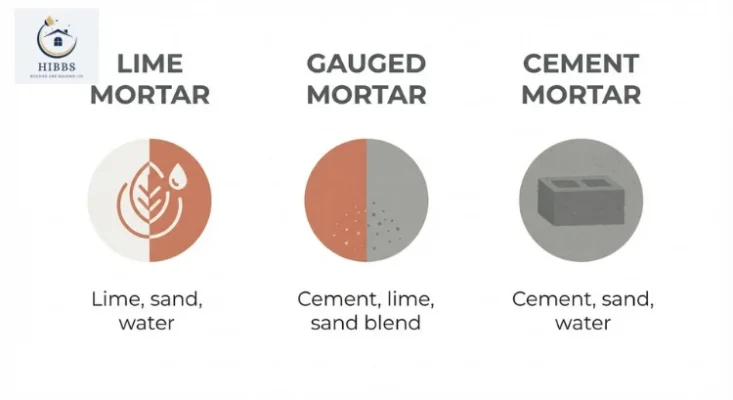
Most homeowners only ever hear about the first two, which is exactly why so many older properties end up repointed with the wrong material.
What Is Lime Mortar?
Definition: Lime mortar is a traditional mix of lime, sand, and water, used in UK building for centuries, long before Portland cement existed.
Key benefits:
- Breathable, allowing moisture to pass through the joint and evaporate rather than getting trapped
- Flexible enough to move slightly with the building without cracking
- Softer than the brick or stone around it, so it wears out first and protects the masonry, exactly as sacrificial mortar should
Disadvantages:
- Takes longer to cure and needs protection from rain and frost while it does
- More expensive, both in materials and labour, since it requires more careful handling
- Not suitable for every property; using it where it isn’t needed adds cost without adding benefit
What Is Cement Mortar?
Definition: Cement mortar is a modern mix of Portland cement, sand, and water, sometimes with plasticisers added, that sets hard and strong.
Key benefits:
- Sets quickly, which suits faster-paced building work
- Genuinely strong, well suited to dense, modern engineering bricks
- Easy to source and mix, keeping costs down on suitable projects
Disadvantages:
- Far less breathable than lime, which becomes a real problem on older walls
- Rigid rather than flexible, so when the building moves, something else has to give, usually the brick
- Used on the wrong property, it traps moisture and can cause lasting damage rather than protecting the wall
Is There A Middle Ground? Gauged Mortar Explained
This is the part most lime-vs-cement comparisons skip entirely, and it’s genuinely useful to know about.
Gauged mortar blends cement, lime, and sand, commonly in a ratio of 1 part cement to 1 part lime to 6 parts sand, sometimes written as 1:1:6. The added cement gives it slightly more early strength and a faster set, while the lime keeps it reasonably breathable, just not to the same degree as pure lime.
It’s a sensible middle option for properties that don’t fit neatly into “clearly pre-1920s” or “clearly modern,” particularly homes built between the wars, roughly the 1920s to 1950s. Getting the ratio right matters, though; too much cement tips the mix back toward cement’s downsides, so don’t guess.
Lime Mortar vs Cement Mortar: Key Differences
| Lime Mortar | Cement Mortar | |
|---|---|---|
| Breathability | High, lets moisture escape | Low, traps moisture |
| Flexibility | Moves with the building | Rigid, doesn’t accommodate movement |
| Strength | Deliberately softer than the masonry | Harder, sometimes stronger than the brick itself |
| Best suited to | Pre-1920s solid-wall properties | Post-1950s cavity-wall construction |
| Setting time | Slow, needs protection while curing | Fast |
| Typical cost | Higher | Lower |
Two Simple Tests To Check Which Mortar Your Wall Needs
Before assuming which mortar your property needs, or which one is already there, two quick checks can point you in the right direction.
Test the brick
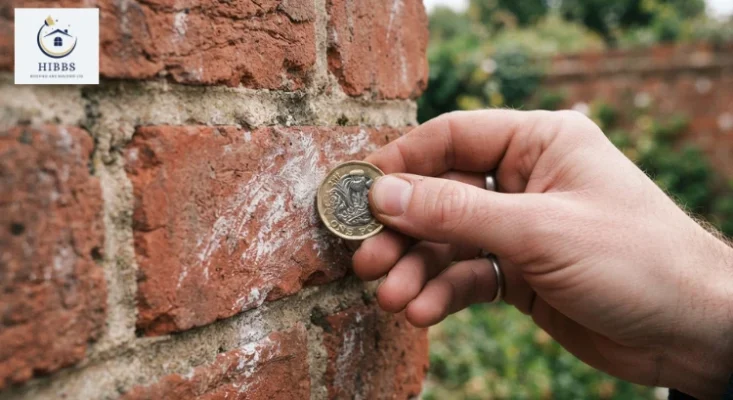
Scratch the surface of a brick gently with a coin. If the coin leaves a visible mark, the brick is soft, and lime mortar is very likely the safer choice. If the coin barely leaves a mark, the brick is hard enough that cement mortar may be appropriate.
Test the existing mortar
Press a key or a flathead screwdriver into a mortar joint. If it scratches away easily, that’s lime mortar. If it barely marks at all, it’s cement.
Neither test replaces a proper survey, but both give you a genuinely useful first read on what you’re actually dealing with before you call anyone.
Best Mix For Repointing, By Property Age
As a general guide, not a rigid rule:
| Property Age | Typical Construction | Recommended Mix |
|---|---|---|
| Pre-1920s | Solid brick or stone, no cavity | Lime mortar |
| 1920s to 1950s | Transitional, some solid wall, some early cavity | Gauged mortar (lime and cement blend) |
| Post-1950s | Cavity wall, denser modern brick | Cement mortar |
Exceptions exist on both ends: a pre-1920s property with unusually hard bricks, or a later property built with softer, reclaimed brick, so this table is a strong starting point, not a substitute for actually checking your specific walls. If you’re not sure which category yours falls into, a proper on-site assessment settles it quickly. At Hibbs Roofing and Building Ltd, we offer repointing services in Ashford and can tell you exactly what your property needs before any work starts.
What Happens If You Use The Wrong Mortar?
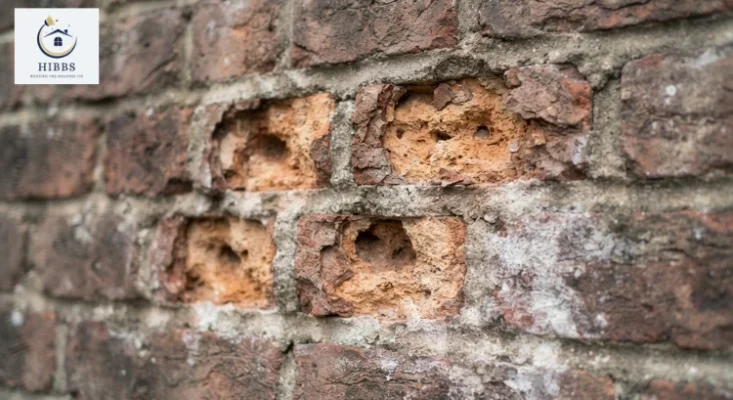
Using cement mortar on an older, lime-built property leads to a predictable chain of problems. Moisture that would normally pass through the joint and evaporate instead gets trapped inside the wall. With nowhere else to go, it forces its way out through the brick face instead, which is softer than the hard cement joint around it. Over time, this shows up as spalling, where the outer face of the brick flakes and crumbles away, along with damp patches and salt staining on interior walls.
Lime mortar has a particularly interesting property that helps it avoid this problem: it can partially self-heal. As lime within tiny cracks reacts with carbon dioxide in the air, it slowly hardens again, gradually closing minor fissures on its own. Cement mortar has no equivalent; once it cracks, it stays cracked.
Does Mortar Type Affect Repointing Cost?
Yes, noticeably. Lime mortar repointing typically costs more per square metre than cement, since it needs more careful application and protection while curing; ready-mixed lime also costs more than site-mixed, though it guarantees a more consistent result. For exact figures by property size and mortar type, see our full repointing cost guide.
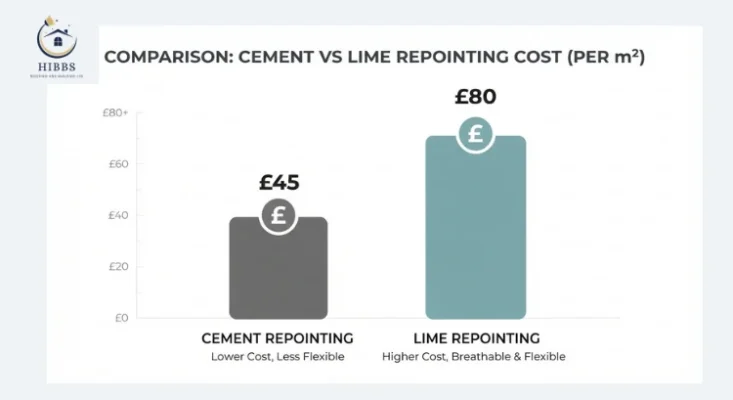
The honest way to think about it: lime costs more upfront, but on a property that actually needs it, using cement instead often costs far more later, once trapped moisture starts damaging the brick itself.As trusted roofing contractors in Ashford, we back that pricing with reviews worth checking before assuming the cheapest quote is the best value.
Conclusion
The “best” mortar mix for repointing was never really a lime-versus-cement contest; it’s about matching the mix to your property’s age and construction. Pre-1920s homes need lime. Modern cavity-wall properties usually work well with cement. Plenty of homes in between suit a gauged blend of the two. Getting this wrong doesn’t just look slightly off; it can seriously damage brickwork that’s stood for a century or more.
Not Sure Which Mortar Your Property Needs?
The team at Hibbs Roofing and Building Ltd will take a proper look and tell you honestly what your property actually needs, rather than applying whatever’s quickest.
Frequently Asked Questions
Can you add cement to lime mortar?
Yes, in the right proportion, this is exactly what gauged mortar is: typically, one part cement to one part lime, and six parts sand. Adding too much cement, though, pushes the mix back toward cement’s downsides: rigid and less breathable, so this isn’t something to guess at without guidance.
How can I tell if my house was previously repointed with cement?
Look for hard, uniform grey joints that appear noticeably newer than the surrounding brickwork, along with nearby flaking or crumbling brick faces. Both are strong signs that cement mortar has trapped moisture and forced it out through the brick rather than through the joint.
Do I need permission to repoint a listed building?
Small, like-for-like repairs using matching lime mortar generally don’t require consent. Repointing a whole wall or elevation, or using a different mortar type than the original, usually does, and carrying out that work without consent is a criminal offence.
How long does repointing last?
Lime mortar typically lasts 50 to 100 years when applied correctly, thanks to its flexibility and self-healing properties. Cement mortar tends to last 20 to 40 years, and often less on older brick, where it can cause damage that shortens the wall’s life, not just the mortar’s.
Can I repoint in winter?
Don’t apply lime mortar when frost is likely, as it needs several days above 5°C to cure properly. Cement mortar is more frost-tolerant once set, but you still shouldn’t apply it during freezing conditions. Spring and autumn are generally the safest windows for either.
What are the signs my property needs repointing?
Look for mortar that’s crumbling, cracked, or missing between bricks; damp patches on interior walls; and joints that have receded more than a few millimetres from the brick face. Left unaddressed, these let water into the wall structure, not just the joint.
Does repointing fix damp problems?
It can help if the damp is caused by failed or incorrect mortar letting water in, but repointing alone won’t resolve damp from other sources, such as faulty guttering, rising damp, or condensation. A proper survey should identify the actual cause before repointing is treated as the fix.
How much does repointing cost per square metre?
Cement repointing typically costs less per square metre than lime, though exact pricing depends on wall height, access, and how much existing mortar needs raking out first. Getting a site-specific quote is the only way to know the real cost for your property.

Pingback: What Is Repointing & Why Does It Matter?