
Most UK roofs last 20-60 years, but it depends on the material. Slate and clay tiles can last 100 years, while flat roofs like felt, GRP and EPDM usually last 15-40 years. Good maintenance can add decades either way. If you’re wondering how long a roof will last, the honest answer is: it depends on what it’s made of. A slate roof can outlive the house it sits on, while a basic felt flat roof might need replacing within 20 years.
Average Roof Lifespan by Material
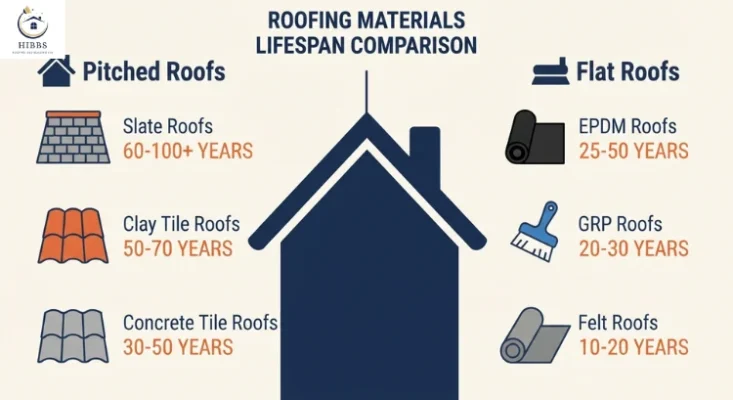
Here’s a quick overview before we go into detail on each one, ranging from the shortest-lived felt roof to slate, the longest-lasting roofing material available in the UK.
| Roofing Material | Typical UK Lifespan |
|---|---|
| Natural slate | 80–150+ years |
| Clay tiles | 50–100+ years |
| Concrete tiles | 40–60 years |
| Metal roofing (steel/aluminium) | 40–70 years |
| Metal roofing (copper/zinc) | 100+ years |
| EPDM rubber (flat) | 20–40 years |
| GRP fibreglass (flat) | 20–30 years |
| Felt (flat) | 15–20 years |
| Lead sheet | 50+ years |
How Long Does A Pitched Roof Last by Material?
Pitched roofs make up the vast majority of UK homes, and the lifespan gap between materials is huge. Steeper roofs shed rainwater quickly, which helps explain why pitched roofs generally outlast flat ones. Here’s how the most common coverings compare.
Natural Slate
Natural slate is the longest-lasting roofing material available in the UK, often reaching 80-150 years, and sometimes longer with high-grade Welsh slate. Slate roof lifespan is rarely limited by the slate itself failing; usually, the nails or fixings holding it in place go first. Copper or stainless-steel fixings last far longer on a slate roof than cheap iron ones. Historic England’s guidance on maintaining older roofs also notes that retaining original slate sizing and laying methods matters just as much as fixing quality when re-roofing period properties.
Clay Tiles
Clay tiles are traditional, tough, and well-suited to the UK’s wet climate, typically lasting 50-100 years. Handmade clay can push past the century mark, since the colour is fired right through the tile rather than coated on top, so it doesn’t fade over time.
Concrete Tiles
Concrete tiles are the most common covering on post-war UK homes, offering a solid 40-60 years of service at a much lower cost than slate or clay tiles. Concrete tile roof lifespans tend to hold up well for a budget option, though tiles do fade and become slightly porous with age.
Metal Roofing
Standard steel or aluminium roofing lasts 40-70 years and copes well with UK weather, provided coastal salt exposure hasn’t accelerated corrosion. Premium metals like copper and zinc are considered a lifetime investment and often last 100 years or more.
How Long Does a Flat Roof Last by Material?
Flat roofs have a tougher job than pitched ones. With no slope to help water run off, the covering must handle standing water, summer heat, and winter frost at once. That’s why flat roof materials generally don’t last as long, and why choosing the right one matters even more. Installation quality also counts for more on a flat roof, since even a small gap in the seams or upstands gives water a direct route in. Most flat roofs sit on extensions, garages and dormers, so they’re usually smaller and easier to inspect regularly than a full pitched roof.
Felt
Traditional felt is the cheapest flat roofing option and, unsurprisingly, the shortest-lived, typically lasting 15-20 years before cracking, blistering or lifting at the edges.
EPDM Rubber
EPDM rubber copes very well with the UK’s rain and temperature fluctuations, and usually lasts 20-40 years. It’s fitted as a single sheet with very few joints, so far fewer weak points than felt.
GRP Fibreglass
GRP (fibreglass) provides a seamless, fully bonded surface that resists water extremely well and generally lasts 20-30 years. It’s rigid rather than flexible, so on larger roofs it can crack over time if not laid correctly.
Lead Sheet
Lead is the most expensive flat roofing option, but also one of the most durable, often lasting 50 years or more when installed properly, and it’s still the go-to choice for valleys, chimneys and flashing details.
Hibbs Roofing and Building Ltd fit EPDM rubber, GRP fibreglass and torch-on felt across Ashford and the surrounding areas. If you’re not sure which flat roofing material suits your extension or garage, our team can talk you through the options.
What Affects The Roof’s Lifespan?
The material sets the ceiling for how long a roof should last, whether that’s a decades-long slate roof lifespan or a shorter-lived felt covering, but a few other factors determine whether you actually get near that figure.
Installation Quality
Even the best material fails early if it’s fitted badly. Loose fixings, poor overlaps, and incorrect flashing are among the most common reasons a roof needs attention years before it should. Roofs installed to NHBC Standards benefit from a recognised benchmark for artistry and material specification, which is one reason installation quality varies so much between contractors.
UK Weather
UK weather conditions, including heavy rainfall, strong winds, and repeated freeze-thaw cycles, put roofs under constant stress. Coastal properties face an extra challenge, too, as salt-laden air accelerates corrosion of metal fixings.
Roof Pitch
A steeper roof drains and dries faster, helping both the covering and the fixings last longer. Low-pitch roofs hold onto moisture for longer, which speeds up wear.
Ventilation
Poor loft ventilation causes condensation to build up, which rots timber and degrades materials from the inside. It’s often the hidden difference between a roof that lasts 30 years and one that reaches 60.
An honest, in-person assessment is the only way to know for sure how long your roof can last. Hibbs Roofing and Building Ltd offer quality roof installation services in Ashford and surrounding areas, so you get a clear answer before spending a penny.
Signs Your Roof Is Reaching the End of Its Life
Some signs mean you need a roofer straight away. Others mean it’s worth booking an inspection soon. If you’re already noticing changes, our guide on signs your roof needs repair explains them in more depth.
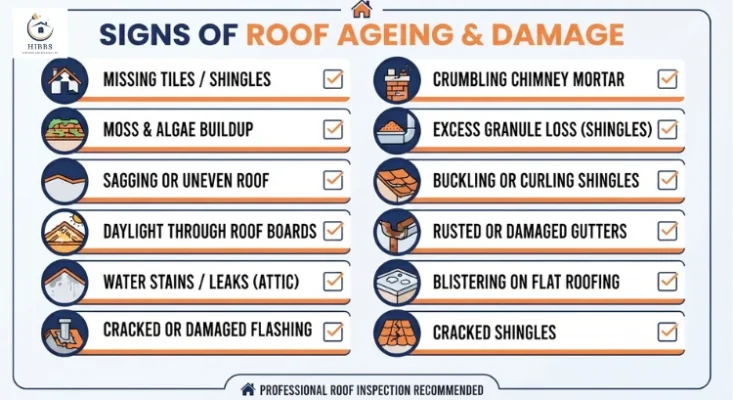
- Active leaks or damp patches on ceilings
- A sagging or dipping roofline
- Daylight visible through the loft boards
- Missing tiles or slates after a storm
- Curling, cracking or brittle tiles
- Heavy moss or algae growth
- Granules building up in the gutters
- Damaged flashing around chimneys or skylights
If you spot any of the first four, call a roofer straight away. The rest are worth a scheduled inspection within a few weeks.
How To Make A Roof Last Longer?
Good maintenance can add years, sometimes decades, to almost any roof, and none of it needs to cost much. It mostly comes down to spotting small problems before they become expensive ones, not special skills or equipment. A handful of simple habits, done consistently, can make a bigger difference to a roof’s lifespan than the material itself in many cases. Here’s what actually moves the needle
Get It Inspected Twice a Year
Spring and autumn checks catch damaged tiles, blocked gutters, and early moss growth before they become bigger problems. A quick walk around the outside with binoculars, plus a look in the loft for damp patches or daylight, is usually enough to spot trouble early. Catching a loose tile or a cracked ridge at this stage is a five-minute fix, not a full repair job later.
Keep Gutters Clear
Blocked or overflowing gutters put extra strain on the roof edge and fascia boards. Leaves and moss build up fast in autumn, and once water starts backing up under the tiles or over the fascia, it can lead to rot that spreads well beyond the guttering itself. Clearing them out once or twice a year is a simple job that prevents a much bigger one.
Deal with Small Issues Quickly
A single slipped tile seems minor, but it lets water reach the timber underneath, which is a far more expensive fix than the tile itself. Fixing small problems the same month you notice them is almost always cheaper than waiting.
A quick check twice a year costs very little compared to an emergency repair bill later. If it’s been a while since your roof was last checked, Hibbs Roofing and Building Ltd can do a free inspection and flag anything worth watching.
Conclusion
How long a roof lasts comes down to the material, whether that’s a long slate roof lifespan or a shorter-lived flat covering, the quality of the fit, and how well it’s looked after over the years. Regular checks and prompt repairs get you the most out of it, whatever it’s covered in.
If you’re unsure how much life is left in yours, Hibbs Roofing and Building Ltd offer free, no-obligation inspections across Ashford, Royal Tunbridge Wells, Canterbury and the surrounding areas. Get in touch today for honest advice on repair versus replacement.
Frequently Asked Questions
Does the colour of roof tiles affect how long they last?
No, colour itself doesn’t affect lifespan much. What matters more is whether the colour is fired into the tile (as with clay) or applied as a coating, since coatings fade faster than the material underneath.
Can a roof be repaired instead of fully replaced if it’s leaking?
Yes, in most cases. A leak on its own, especially from a single slipped tile or damaged flashing, is usually a straightforward repair rather than a sign the whole roof needs replacing.
Is it worth paying more for a longer-lasting roofing material?
Yes, if you’re planning to stay in the property long-term. Materials like slate, still the longest-lasting roofing material available in the UK, or clay cost more upfront but can outlast two or three cycles of a cheaper covering.
Does roof insurance cover normal wear from age?
No. Standard buildings insurance covers sudden damage, such as storms, but not gradual wear and tear from age, which is treated as a maintenance issue rather than a claimable event.
