
Quick answer: “Rising damp shows as a tide mark and white salts on the bottom metre of a ground-floor wall, and stays roughly the same regardless of the weather. Penetrating damp is a defined patch that appears or worsens during and after rain, usually linked to an external defect such as a broken gutter or a slipped tile. Condensation is black spotty mould on cold surfaces such as windows, corners and behind furniture, and it’s worst in winter. Rising damp vs penetrating damp vs condensation ultimately comes down to where the moisture is showing up and what triggers it; each one needs a completely different fix, so knowing which type you have is the first step, not the treatment itself.“
Why Getting The Right Diagnosis Matters
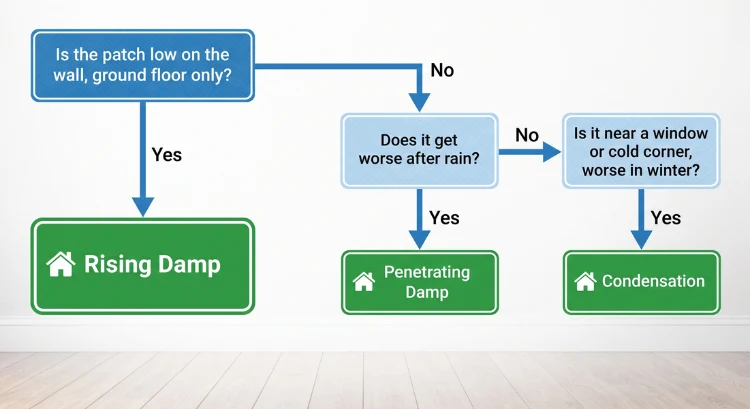
Damp is one of the most commonly misdiagnosed problems in UK homes, and getting it wrong is expensive. Fitting a chemical damp-proof course into a wall that’s actually suffering from condensation won’t touch the mould, because the moisture was never rising from the ground in the first place, and the homeowner is left with the original problem plus a fresh bill. There are several types of damp in houses, and each one can produce stains, peeling paint, or mould that can look almost identical to the untrained eye. Learning to read the location, pattern and timing of the damage is what separates a correct diagnosis from an expensive guess, and it’s why we always start with an inspection rather than a quote. If you’re weighing up whether treatment is worth it, see how much damp proofing costs in Ashford before booking a survey.
Rising Damp vs Penetrating Damp vs Condensation
What Is Rising Damp?
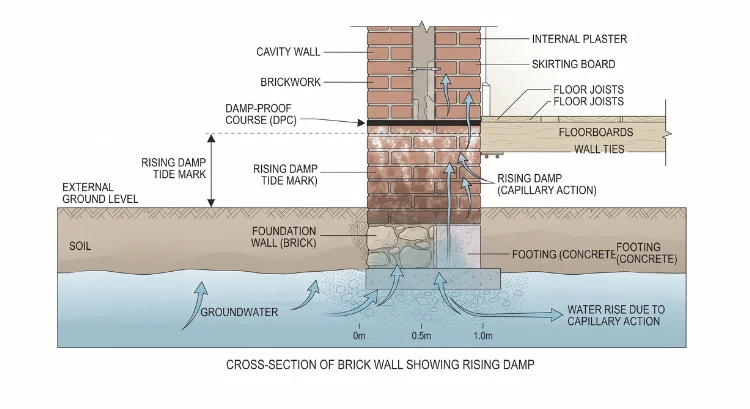
Rising damp happens when moisture from the ground is drawn up through a wall by capillary action, usually because the damp proof course (DPC) has failed, been bridged, or was never installed. It’s a genuine problem in older Ashford properties, but it’s also over-diagnosed, since a raised flower bed or path bridging the DPC can produce very similar symptoms without any real defect in the damp course itself. Knowing how to identify rising damp correctly, rather than assuming it from a single damp patch, is what stops homeowners paying for treatment they don’t actually need.
Signs Of Rising Damp
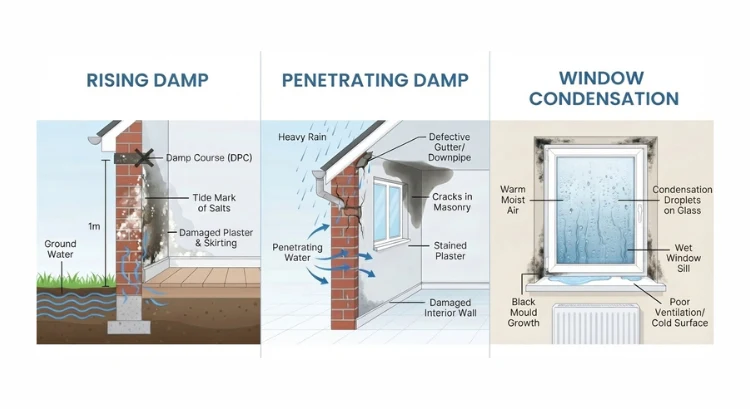
- A horizontal tide mark roughly 300mm to 1 metre above the skirting board
- White, powdery salt deposits (known as efflorescence) on the plaster or brickwork
- Crumbling plaster, rotting skirting boards, and peeling wallpaper starting from the bottom up
- Confined to ground-floor walls only, and fairly constant regardless of the weather
Causes Of Rising Damp
Rising damp is almost always linked to a damp proof course that has failed with age, been bridged by external ground levels, paving, or render, or was never fitted at all in older, pre-1875 properties. In Ashford’s Victorian and Edwardian terraces, it’s common to find slate or bitumen DPCs that have simply broken down after a century of ground movement, alongside more recent extensions where paving was laid too high against the wall. A proper diagnosis checks both possibilities before any work is agreed.
How To Fix Rising Damp
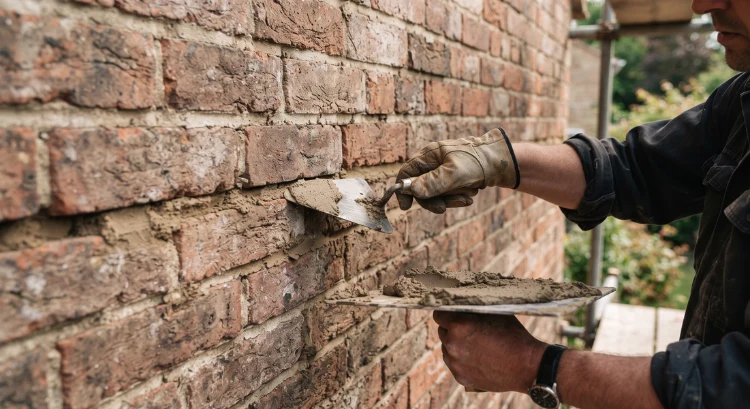
A genuine rising damp problem requires a new chemical DPC to be injected into the base of the wall, in line with the guidance set out in BS 6576, removal of anything bridging the existing course, and replastering with a salt-resistant render. Old plaster retains hygroscopic salts that continue to draw in moisture even after the wall has dried out, so skipping the replaster step is one of the most common reasons rising damp treatments fail and the tide mark reappears within a year or two.
What Is Penetrating Damp?
Unlike rising damp, penetrating damp can appear at any height and on any floor. It’s water forcing its way in horizontally through a defect in the building’s outer fabric, and it tracks closely with the weather, worsening noticeably during wet spells and settling down once the property has had a few dry days to recover. Because it can show up almost anywhere on a wall or ceiling, it’s often the type most easily mistaken for a hidden plumbing leak.
Signs Of Penetrating Damp
- A defined, often irregular patch that darkens noticeably during or after rain
- Can appear on ceilings, chimney breasts, or upper-floor walls, not just at ground level
- Blown plaster or peeling paint concentrated around the damp patch
- Dries out somewhat in settled, dry weather
Causes Of Penetrating Damp
The usual culprits are a slipped or cracked roof tile, a blocked or leaking gutter and downpipe, perished pointing, cracked render, or a failing flat roof or chimney flashing. Solid, older walls that take the brunt of driving rain are especially prone, since they lack the cavity that modern construction uses to stop water reaching the inner leaf. Knowing how to identify penetrating damp usually means stepping outside during or just after rainfall and tracing the affected area back to whatever defect sits above or behind it.
How To Fix Penetrating Damp
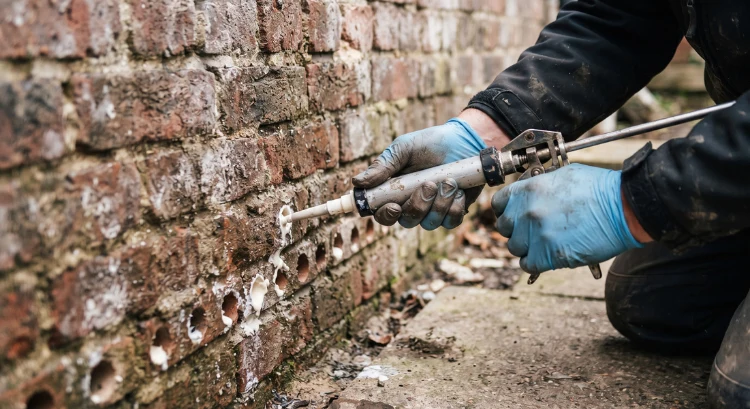
Always deal with the external defect first, whether that’s a roof repair, guttering replacement, or repointing, then let the wall dry out fully before making good the plaster and decoration inside. Treating the inside without fixing the outside just means the stain comes back after the next spell of heavy rain, and any redecorating done beforehand is wasted money. A methodical, weatherproofing-led approach is the only way to get a lasting result.
What Is Condensation?
Condensation is by far the most common form of damp in UK homes, and it’s the one most often confused with the other two. It isn’t water coming in from outside; it’s moisture already inside the home, from cooking, showering, drying laundry and even breathing, settling on cold surfaces once the air can’t hold any more water vapour. Because it’s driven by everyday living rather than a structural fault, it’s also the type most within a homeowner’s control to reduce.
Signs of Condensation
- Black, spotty mould around window frames, room corners and behind wardrobes or sofas
- Streaming or dripping windows, especially first thing in the morning
- A persistent musty smell in rooms with poor airflow
- Worse in winter, when surfaces are coldest, and windows stay shut
Causes of Condensation
Condensation comes down to a balance between how much moisture a household produces, how well the property is ventilated, and how warm the internal surfaces are. Drying clothes on radiators, blocked trickle vents, unused extractor fans, and cooking without a lid all increase the amount of moisture in the air beyond what a typical home can safely absorb. Poorly insulated external walls make the problem worse still, since cold surfaces are exactly where airborne moisture condenses first.
Solving Condensation Without Damp-Proofing
The answer is ventilation and heating, not damp-proofing. Extractor fans in kitchens and bathrooms, background ventilation, and steady, low-level heating rather than short bursts all help keep surfaces above the temperature at which moisture condenses. In persistent cases, a whole-house positive input ventilation (PIV) unit can make a lasting difference. A hygrometer is a simple, inexpensive way to check whether indoor humidity is running higher than it should before committing to any bigger works.
Rising Damp vs Penetrating Damp vs Condensation: At a Glance
Comparing rising damp vs condensation, or penetrating damp vs condensation, side by side makes the differences much easier to spot than reading about each one separately. The table below is a useful starting point for narrowing things down, though it should always be followed up with a proper on-site inspection rather than relied on alone.
Rising Damp | Penetrating Damp | Condensation | |
Where it appears | Bottom metre of ground-floor walls only | Any height, any floor, near the external defect | Cold surfaces: windows, corners, behind furniture |
Key sign | Tide mark with white salt deposits | Defined patch, darkens after rain | Black spotty mould, streaming windows |
Weather pattern | Fairly constant, doesn’t track rainfall | Appears or worsens during and after rain | Worse in winter and cold mornings |
Root cause | Failed, bridged or missing DPC | External defect: roof, guttering, render, pointing | Indoor moisture meeting cold, poorly ventilated surfaces |
Correct fix | New DPC and replastering | Repair the external defect, then dry out | Ventilation, heating, and insulation |
Why Ashford’s Period Properties Need Extra Care
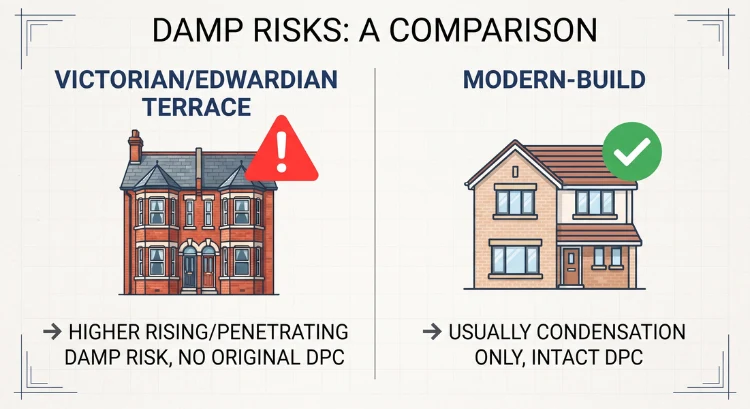
Ashford and the surrounding Kent villages have a large stock of Victorian and Edwardian terraces, along with period cottages that predate modern damp proof courses altogether. These properties are naturally more prone to genuine rising and penetrating damp, but their solid walls and original detailing also mean the wrong treatment can do more harm than good, trapping moisture behind modern renders and creams that were never designed for a lime-built wall. A proper inspection that checks the roofline, guttering, pointing and ground levels alongside the internal symptoms, ideally backed by moisture meter readings rather than a quick visual guess, is the only reliable way to know which of the three you’re dealing with. Hibbs Roofing and Building Ltd’s damp proofing services in Ashford cover exactly this kind of diagnosis across Ashford, treating rising damp, penetrating damp and condensation issues at the source rather than guessing.
Signs It’s Time To Call In A Specialist For Damp Proofing
If mould keeps returning within weeks of cleaning, a patch never seems to dry out regardless of the weather, or you’re not sure whether a stain is coming from outside, inside, or the ground, it’s time to get a proper inspection rather than guessing with a shop-bought damp meter. Independent bodies such as the Property Care Association (PCA) and RICS both recommend an evidence-led survey before any damp-proofing work is agreed, since the diagnosis matters just as much as the treatment itself. As experienced roofers in Ashford, our team traces damp back to its actual source, whether that’s a roofing defect, failed guttering, or a genuine DPC problem, before recommending any work.
You can contact us today for a free, no-obligation inspection and a clear, honest quote before anything is agreed.
Conclusion
Rising damp, penetrating damp, and condensation can look almost identical on the surface, but each has a completely different cause and requires a completely different fix. Rising damp sticks to the bottom of ground-floor walls and stays fairly constant, penetrating damp tracks the rain and can appear anywhere, and condensation is about indoor moisture meeting cold surfaces. Getting the diagnosis right before any work starts is what saves you from paying for a treatment that was never going to solve the problem, and it’s a step worth taking seriously rather than rushing. If you’re an Ashford homeowner dealing with damp patches or mould and aren’t sure which type you’re facing, a proper inspection is always the more affordable option in the long run. Get in touch, and we’ll help you get to the bottom of it.
FAQs
Can rising damp appear on a first-floor wall?
No. Rising damp is limited to roughly a metre above the skirting board on ground-floor walls, because capillary action can’t lift water any higher. Damp upstairs is almost always penetrating damp or condensation.
Does opening a window help with condensation?
Yes, it provides short-term relief by letting moist air escape, but it won’t fix the underlying problem on its own. Lasting results need proper ventilation, extractor fans, and steady heating.
Is penetrating damp always linked to rainfall?
Yes, it typically appears or worsens during and after rain, since it’s caused by water entering through an external defect. A patch that stays wet in dry weather too is more likely a hidden leak.
Can a chemical damp-proof course fix condensation?
No. A chemical DPC only addresses ground moisture rising through a wall, so it does nothing for condensation, which comes from moisture already inside the home.
Do all older Ashford homes have rising damp?
No. Many show similar symptoms caused by a bridged damp proof course, blocked airbricks, or condensation rather than genuine rising damp.
